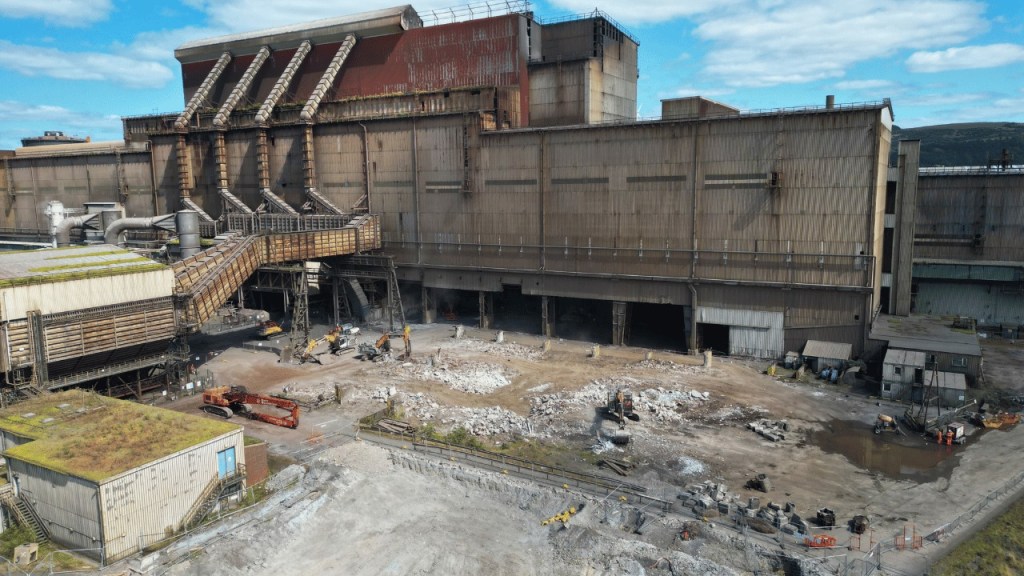
The video, posted on Tata’s Facebook page, takes viewers back inside the vast BOS Plant — once the beating heart of blast furnace steelmaking — where crews are tearing out decades‑old infrastructure to make way for the new low‑carbon process.
The update shows huge sections of the former hot metal and charging bays stripped back to bare concrete, with legacy equipment, weighing stations, diesel points and even the giant charging cranes now being dismantled. The cavernous building, once filled with molten iron and the roar of converters, is described as “a cathedral” now reduced to a shell as enabling works accelerate.
Project engineers explain that the cleared space will become the EAF shell workshop, where the furnace’s massive components will be assembled and maintained. At the south end of the plant, contractors Sir Robert McAlpine are preparing the installation zone for the furnace itself — a transformation that involves digging out old pits, levelling entire bays and installing new piling across the site.
Tata says the work is “laying the foundations for a new, low‑CO₂ steelmaking process” and marks the next chapter of UK steelmaking. The company insists the EAF will secure the long‑term future of the site, even as thousands of traditional steelmaking jobs disappear.
A year of upheaval for steelworkers
Over the past year, Swansea Bay News has followed every twist in Port Talbot’s steel saga. What began with warnings of weak demand soon spiralled into a series of hammer blows for workers — from Christmas shutdowns that slashed pay packets to the announcement that 2,800 jobs were at risk as Tata confirmed its plan to close the blast furnaces.
The uncertainty has fuelled political rows in Cardiff and Westminster, with unions accusing Tata of refusing to wait for Labour’s promised investment and MPs warning of a “betrayal” of steel communities. EU tariffs, global market pressures and soaring costs have only deepened the crisis.
At the same time, the company has pressed ahead with its £1.25bn green transition, signing contracts for new technology, appointing Sir Robert McAlpine to lead the decarbonisation build, and beginning early works on the Electric Arc Furnace. Government funding has been announced, retraining schemes launched, and start‑up grants rolled out to help families prepare for life after steel.
Communities have shown resilience — from welding academies retraining former workers to local leaders fighting to protect jobs — but the financial strain on households has been impossible to ignore. And as demolition crews move through the plant, the physical dismantling of the old steelworks has become a stark symbol of the upheaval facing the town.
Inside the BOS Plant: a steel cathedral stripped bare
In the new video, engineers walk viewers through the vast BOS Plant, pointing out where the old weighing stations, fume hoods, diesel points and hot metal pits once stood. Much of the floor has been ripped up, leaving gaping holes where equipment sat for decades.
The removal of the south charging crane — a job so large it requires opening the roof and bringing in a giant external crane — is described as a “huge undertaking”. The north crane was once installed the same way.
Long‑serving staff speak openly about the emotional toll of dismantling equipment they helped install 35 years ago, even as they acknowledge the need to move forward.
South end transformation: where the new furnace will rise
The video then moves to the south end of the plant, now controlled by Sir Robert McAlpine. The area is almost unrecognisable. Entire bays have been stripped out, old scrap‑handling areas flattened, and deep pits dug out to prepare for the new furnace and ladle metallurgy stations.
Engineers explain how the EAF will sit in the south‑west corner, with new transfer tracks linking the furnace, the ladle furnaces and the caster. Massive piling work will be needed across the entire building to support the new equipment.
Even in its stripped‑back state, the layout of the future steelmaking process is beginning to emerge.
A new era — but at a heavy cost
Tata says the EAF will cut emissions dramatically and modernise the plant, but unions warn the shift will slash jobs and leave the UK dependent on imported steel scrap. The company has already confirmed that large parts of the works will close permanently this year.
Despite the upheaval, Tata insists progress is “well underway behind the scenes” and promises more updates as the project moves forward.
The next major milestone will be the arrival of the EAF shell and equipment — a moment that will symbolise the end of one era of Welsh steelmaking and the beginning of another.