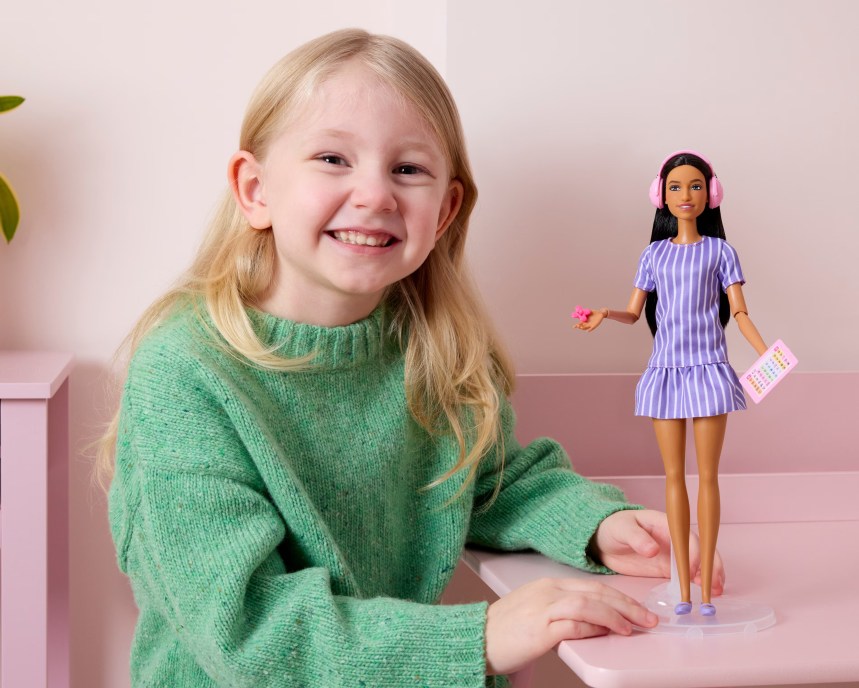
Mattel says the new doll, part of its Fashionistas range, was created over 18 months with the Autistic Self Advocacy Network (ASAN) to reflect experiences familiar to many autistic children. The design includes sensory‑friendly clothing, a sideways eye gaze, and accessories such as noise‑cancelling headphones, a fidget spinner and a tablet with symbol‑based communication apps.
The launch has been welcomed by campaigners and families, who say the doll marks a significant moment for autistic representation in mainstream toys.
Designed with autistic input
The doll’s articulation allows for movements such as stimming and hand‑flapping, while the loose‑fitting dress is designed to reduce fabric‑to‑skin contact. Mattel says these choices were made to reflect tools and behaviours that help autistic people navigate everyday life.
Jamie Cygielman, Global Head of Dolls at Mattel
“Barbie has always strived to reflect the world kids see and the possibilities they imagine. This doll helps expand what inclusion looks like in the toy aisle and beyond.”
Families say representation matters
Families involved in the research told the BBC the impact was immediate. One mother said her five‑year‑old daughter, who uses ear defenders, felt “special” seeing a doll with the same sensory supports. Advocates say that moment of recognition is exactly why authentic representation matters.
The Guardian reported that autistic campaigners see the doll as a milestone, particularly for girls, who are still diagnosed far less often than boys. Advocates say the doll could help challenge misconceptions and normalise visible supports such as headphones and stim toys, which some autistic young people avoid using in public.
Colin Killick, Executive Director of ASAN
“It is so important for young autistic people to see authentic, joyful representations of themselves. This doll celebrates our community and the tools that help us be independent.”
Part of a wider shift in the toy aisle
The autistic Barbie follows recent additions to the Fashionistas range, including dolls with type 1 diabetes, Down syndrome, prosthetic limbs, hearing aids and mobility aids. Until 2019, Barbie had no dolls representing disabilities.
Mattel’s research partnership with Cardiff University has also explored how doll play supports empathy and social understanding, including for children with neurodivergent traits.
Supporting children beyond the toy aisle
To mark the launch, Mattel will donate more than 1,000 autistic Barbie dolls to children’s hospitals in the United States, aiming to bring comfort and representation to young patients.
The doll is now available from major retailers and the Mattel online store.