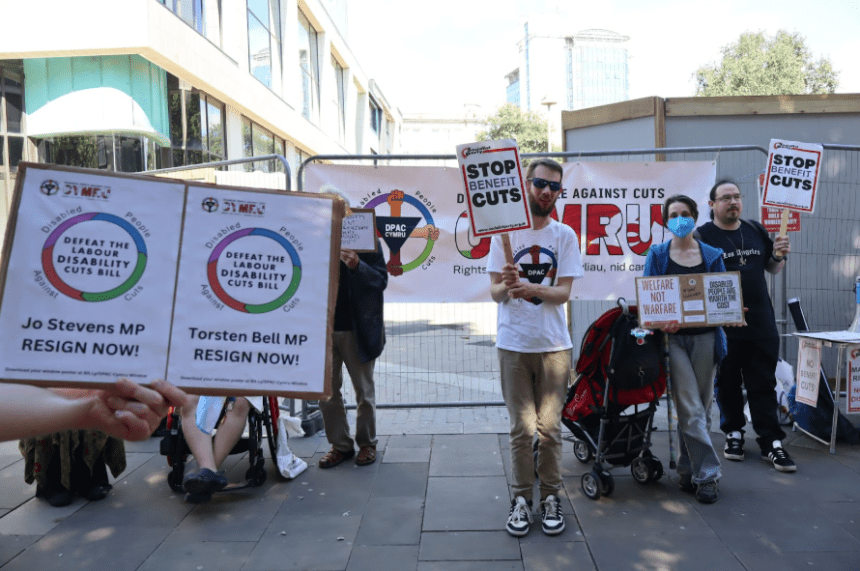
The protest, led by Swansea Disabled People Against Cuts (DPAC), took place on Monday 8th July, just hours before Parliament was due to debate the Universal Credit and Personal Independence Payment Bill at committee stage and third reading. Campaigners say they are proud to have helped secure major concessions from the government, but remain deeply concerned about the bill’s long-term impact.
“We gave it everything we had,” said Ben Golightly, Swansea DPAC spokesperson. “We’re proud of what we’ve achieved, but it’s a partial victory. We don’t want to leave behind young disabled people or those who become disabled in future.”
Following the rally, activists attempted to deliver a letter to management at Swansea’s DWP office, supported by members of the PCS trade union, which represents DWP staff. Security refused to engage, prompting police to attend. Officers offered to deliver the letter on behalf of the group, concluding what Golightly described as “quite possibly the politest direct action ever.”


The protest was timed to avoid disruption to claimants and was intended as a peaceful demonstration against what campaigners call an “undemocratic” legislative process. Swansea DPAC has previously criticised the government for rushing the bill through Parliament without proper scrutiny or consultation.
The bill passed its second reading on 1 July by 335 votes to 260, with 49 Labour MPs voting against the government. In response to mounting pressure, ministers reversed proposed cuts to Universal Credit and agreed to delay changes to Personal Independence Payment (PIP) until after a formal review. Since then, MPs from across parties have tabled more than 30 pages of amendments, which will be debated later today.
Among the most contentious proposals are:
- A government amendment to rename the bill, removing “and Personal Independence Payment” from the title.
- A clause from Labour’s Cat Eccles requiring PIP assessments to be carried out by civil servants, not private providers.
- Amendments from Conservative MPs Helen Whately and Gavin Williamson to exclude foreign nationals from claiming Universal Credit and PIP.
- Proposals to extend eligibility for severe conditions to those with fluctuating illnesses like Parkinson’s and MS.
- A call from Labour’s Stella Creasy to ensure the bill complies with the UN Convention on the Rights of Persons with Disabilities.
The Timms Review, led by disability minister Stephen Timms, will now shape future changes to PIP. Labour MPs have called for the review to be co-produced with disabled people and independently overseen.
Despite the stress and uncertainty, Golightly said the campaign had sparked a new wave of disability activism:
“Their attacks have created a whole new generation of disability activists who are compassionate, capable, knowledgeable, spirited, selfless and kind.”
The group says it will continue to push for full protection of disability benefits and urges others to take action:
“When you see injustice and ask, can I make a difference? The answer is yes. Have hope, organise democratically, work as a team, look after each other, and steer yourself by the trade union slogan: an injury to one is an injury to all.”