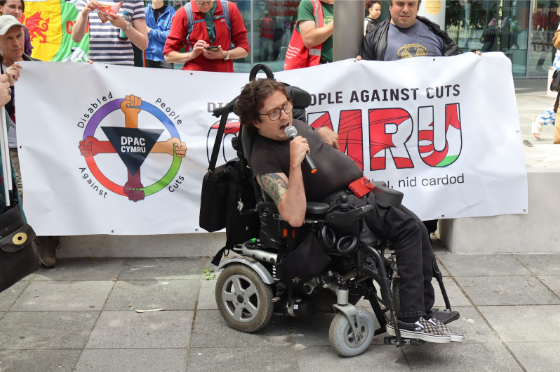
Joshua Reeves is a UK-based disability rights advocate and founder of Don’t Call Me Special. He was awarded the British Empire Medal (BEM) by the late Queen Elizabeth II for services to disability advocacy, and has been leading national and international campaigns for structural reform, equitable access, and independent living for over a decade.
Joshua, who describes himself as “one of the UK’s most outspoken disabled advocates”, says that he was “refused access” to the UK Government’s rescheduled consultation event.
Joshua Reeves BEM said: “On Monday, the Department for Work and Pensions (DWP) launched its so-called Green Paper Consultation Discussion in Cardiff. I was invited to attend as a plus one — as one of the UK’s most outspoken disabled advocates, with over a decade of national and international experience, including representing disabled communities in Antigua in 2017 with the Commonwealth Youth Council.
“I arrived 10 minutes late to a venue that was only technically accessible, and was left outside in 30-degree heat while the event began without me. Despite four DWP note takers being present, no one came out to include me or others facing access barriers. That wasn’t a mistake — it was a message. And let’s be honest: they knew exactly who I was.
“It felt humiliating. Like being silenced in plain sight. I showed up with lived experience, policy insight, and a platform — and was still treated as an inconvenience. This event wasn’t about listening to disabled people. It was about rubber-stamping pre-written plans to dismantle our support systems.
“Under the guise of “engagement,” the DWP is pushing through brutal cuts to lifelines like PIP and Access to Work — systems that are already crumbling. This is not reform. It’s removal — of autonomy, dignity, and survival.
“I am the disabled voice of the voiceless. I don’t ask polite questions when our lives are on the line. If the DWP wants real engagement, they can start by opening the door — literally and politically. Until then, we’ll stop asking for a seat at the table. We’ll build our own.”
Campaigners have criticised the lack of public consultation with disabled people of the plans, particularly in Wales saying there is a “growing atmosphere of fear and anger” about the proposals.
Swansea Disabled People Against Cuts (DPAC) have campaigned on the platform that no Parliamentary vote should take place on disability benefit cuts until there has been a “full and genuine public consultation” in Wales.
Disabled People Against Cuts Cymru (DPAC Cymru), whose individual members had several tickets to the event, said: “Only 15 disabled people were allowed in, under heavy security, conscious of the weight on our shoulders of representing 190,000 people in Wales set to be impacted by the government proposals, at the (only) in-person consultation event. We repeatedly said this was not enough.
“We also made the point that we would have had no in-person consultation at all in Wales, if our protests had not forced them to do better. And this was not much better.”
The spokesperson for Swansea DPAC added: “If our ticket-holding members in wheelchairs had been able to attend the rescheduled consultation, or if Joshua had been allowed in, we seriously doubt their chairs would have even fit in the shoebox of a lift.
“The DWP have repeatedly refused to fund attendee’s personal assistants, leaving them with fewer support hours for the rest of their week. They made it as difficult as possible for personal assistants to attend, not understanding that disabled people do not necessarily know who their PA will be in advance.
“Disabled people attending straight after work, without time for lunch, were promised “light refreshments” by the DWP but were not given a single crumb. We wouldn’t have even had coffee if we hadn’t pushed for it.
“Despite the DWP having four notetakers, they refused to send just one of them to meet the disabled people waiting outside, wanting to be heard. We literally begged them, and they repeatedly refused”.
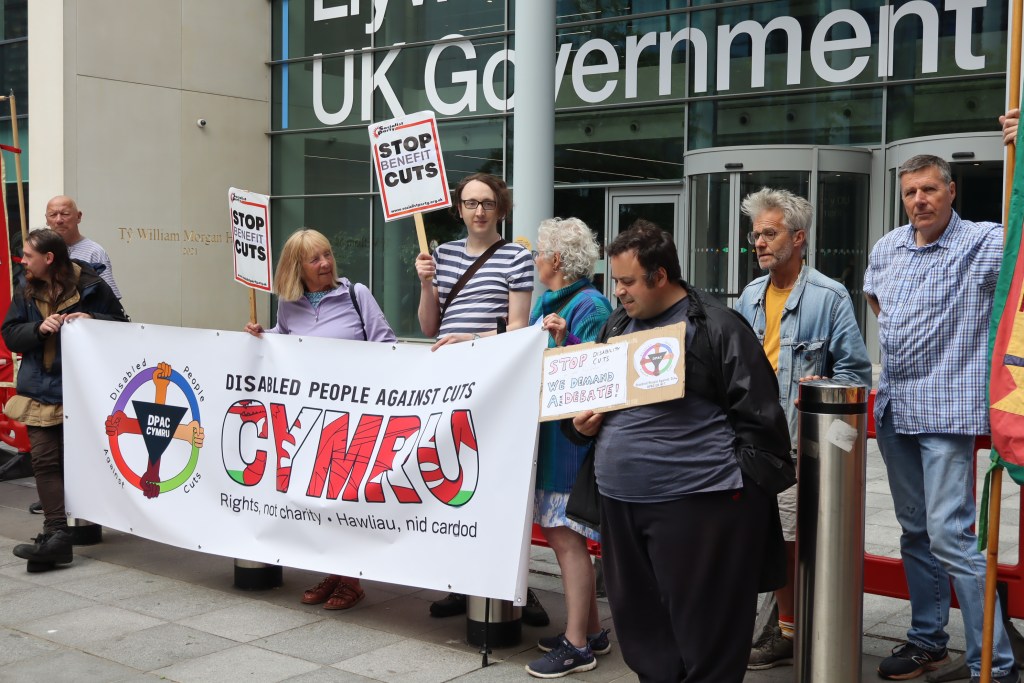
The campaign group described the consultation event as “chaotic” with those giving evidence leaving the room “in distress”.
“It was left to disabled people, not the DWP, to bring order to a chaotic meeting that showed no sign of starting half an hour after it meant to start” the DPAC spokesperson continued.
“By insisting on taking it to a vote, we decided that we would not be split up, we would not limit ourselves to only the permitted questions, and we would take turns to speak and have our say.
“In the meeting, people would give their spoken testimony, then leave the room in distress. Some could barely hold down their nausea, literally sick to their stomachs at the injustice. We also handed in 50 pages of collected written testimony from our own “open air” consultation that we held in place of the previous, cancelled, consultation.
“Not a single disabled person in the room had any faith that the DWP would listen, with the first bill moving through parliament before the consultation has even finished, and MPs not even understanding the full impact. There were obvious gaps in the DWP note taking, and only one of their notetakers looked like they put any effort in. What we said in that room was more for each other.
“Not a single disabled person in attendance had anything other than the most damning condemnations of the government’s proposals, and at the contempt with which we had been treated. Using the government’s own data sources, we tore apart the government’s cherry-picked statistics and talking points, which were so misleading that a schoolchild would know better.
“Disabled people in the room raised, in detail, the impacts on carers, of ESA changes, of means-testing & capital limits, the existing and increasing inequalities for disabled people in relationships and of young people, and many more topics.
“When DPAC Cymru first started engaging with this consultation process, we said that welfare reform should be carried out in a process of co-production with disabled people and carers. At the sham consultation on Monday, we said that we had now gone beyond that. We said that our experience to date has shown that disabled people should be running the process, and disabled people should be running the DWP. We’re the experts on our lives. The government has no clue, and it should listen. This demand got the biggest cheer of all.
“We concluded by pointing out the government’s attacks on everyone – disabled people, carers, trans people, migrants, funding for wars, attacks on public sector workers, including DWP workers. We talked about the recent letter signed, almost overnight, by 300+ trade unionists against benefit cuts. The PCS union, which represents many DWP workers, supported and spoke at our protest outside. We all said we would not let the government away with these attacks.”
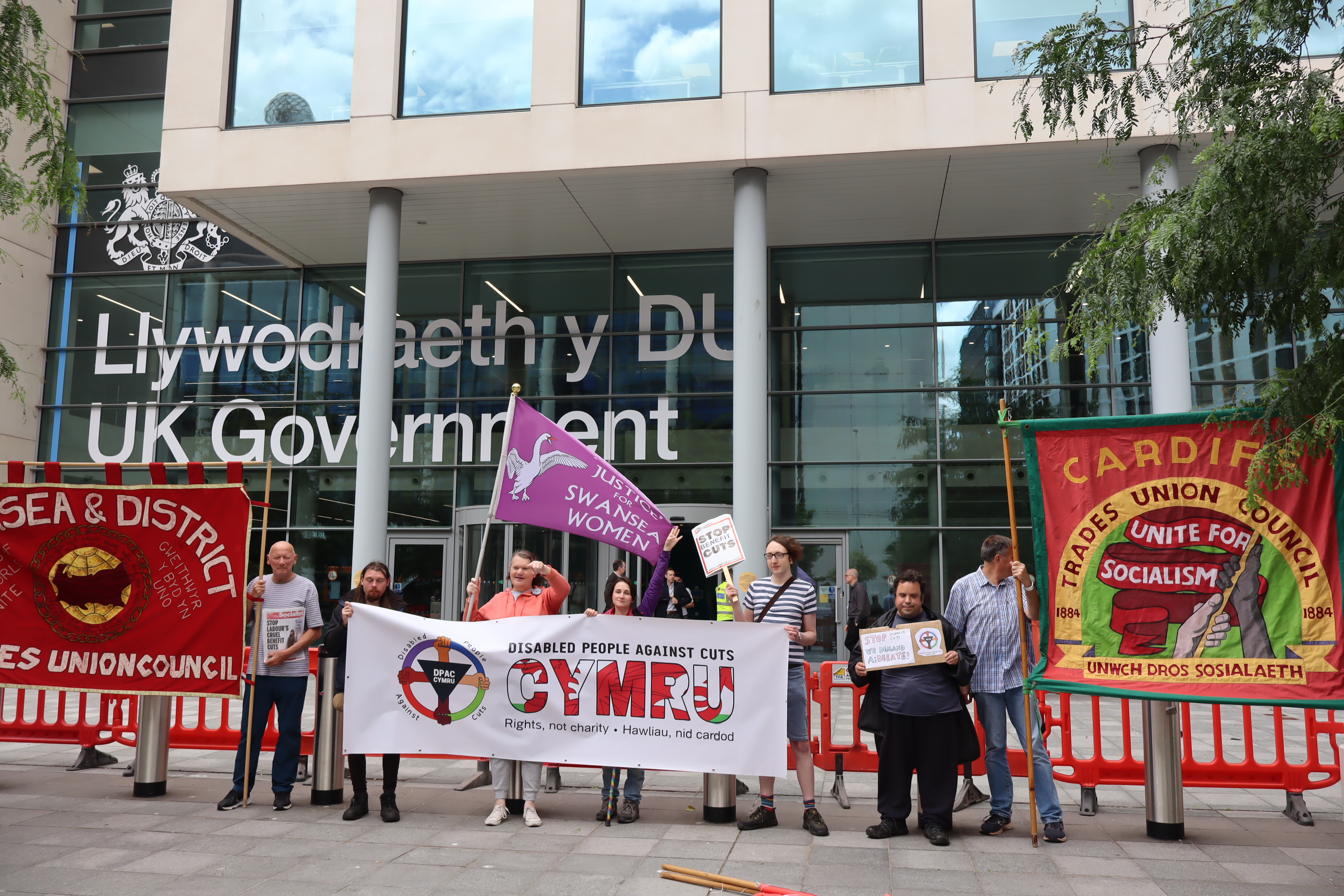
There was a protest outside the consultation, attended by disabled people, trade unionists, socialists and others, in support of the attendees.
The increasingly controversial reforms have seen 108 Labour MPs recently signed an amendment to the Government’s welfare reform bill declining to give the welfare reform Bill a second reading when it returns to the Commons on 1 July.
It was recently claimed that Wales is set to be the worst hit by Labour’s welfare cuts, with at least 90% of people in Swansea and Neath Port Talbot claiming the standard rate of Personal Independence Payment for daily living activities at risk of losing at least some of the payment.