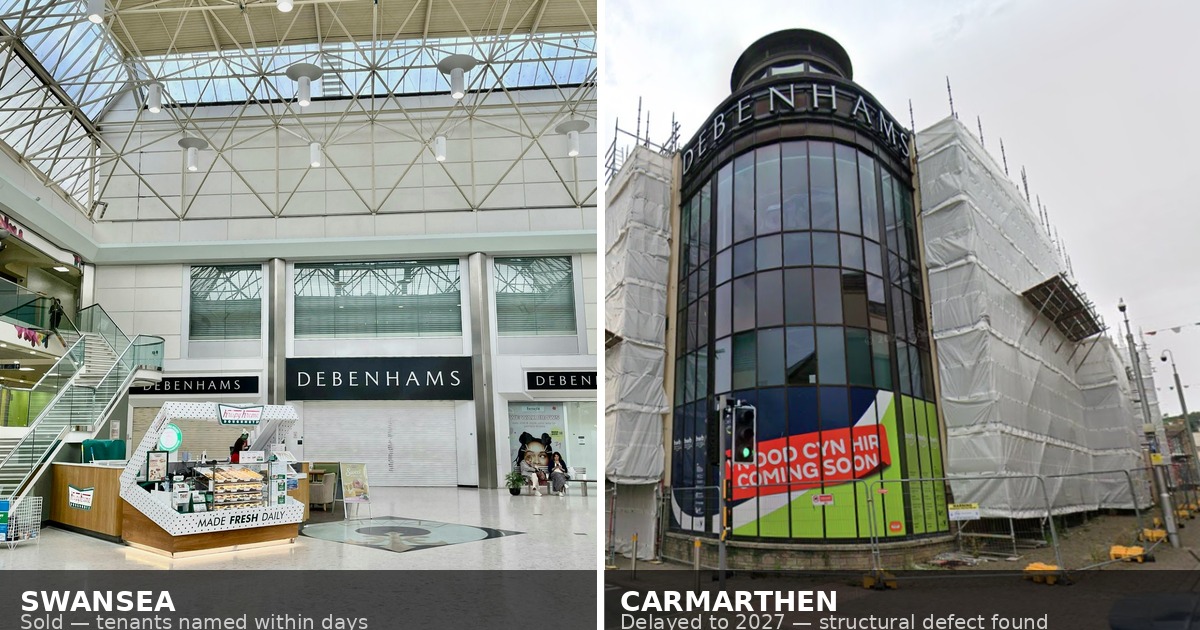
Two former Debenhams buildings sit at the heart of two Welsh town centres – but their stories could not be more different, and the contrast is drawing scrutiny from candidates standing in Thursday’s Senedd election for Sir Gaerfyrddin.
In Swansea, the former Debenhams building in the Quadrant was sold this week to Centurion – the company that already owns the shopping centre – with three major new tenants set to be announced within days. The sale was brokered by Swansea Council after the Welsh Government helped fund the purchase of the building.
In Carmarthen, the picture is more complicated. Carmarthenshire County Council purchased the town’s former Debenhams building and announced plans to transform it into Atriwm, a cultural and community venue – part of a strategy to repurpose large vacant units left by departing chains.
But opening has been pushed back to 2027 after a structural defect was discovered in the building following purchase – a complication the council says forms part of its £146 million capital programme.

Calum Higgins, Welsh Labour’s lead candidate for Sir Gaerfyrddin, said the situation raised serious questions about spending priorities across the county. “There have been some poorly thought out purchases in Carmarthen by the Plaid Cymru led Carmarthenshire County Council, and a lack of investment in towns like Ammanford and Llanelli because money is being sucked up by white elephants,” he said. He is calling for a Senedd inquiry into how local authorities spend money on town centres.
The spending in Carmarthen comes against a backdrop of contested town centre plans for Llanelli and Ammanford set out by the council in September last year.
The masterplan acknowledged that both towns face significant challenges – in Llanelli, the Murray Street multi-storey car park and indoor market beneath it are nearing the end of their structural life, while Ammanford’s plan focused on reconnecting the town centre with surrounding communities and tackling the leakage of shoppers to larger centres.

Llanelli Market has been at the centre of significant controversy since plans emerged in July 2025 to demolish the existing building and relocate to the former Woolworths site, with traders and Labour councillors raising concerns about the process.

Carl Peters-Bond, Mayor of Kidwelly and independent candidate for Sir Gaerfyrddin, said the pattern of spending reflected a wider failure of priorities. “Councils and Welsh Government must start listening to people rather than ploughing blindly on with vanity projects,” he said. “Money seems to be no object when it comes to Carmarthen – yet other market towns across the county are left to survive on whatever grant funding they can find, with all the restrictions and conditions that come with it.”
Peters-Bond said the Llanelli Market move illustrated the problem. “The proposed move to the former Woolworths site is only happening because refurbishment of existing retail is a condition of the grant the council has applied for – not because it is the best outcome for the town or its people,” he said. Carmarthenshire Council has not publicly addressed this specific claim.

Plaid Cymru’s candidate for Sir Gaerfyrddin, Mari Arthur, pointed to a different root cause – arguing that the business rates system was working against town centres across Wales, not just in Carmarthenshire. “A café owner on Stepney Street pays rates that bear no relation to the advantages enjoyed by a big-box retailer on the edge of town,” she said. “That is not a fair system – it is a rigged one.” Plaid’s manifesto commits to restructuring business rates to level the playing field between high-street businesses and out-of-town retail.
Carmarthenshire County Council’s position, as set out in its capital programme, is that the Atriwm project remains a long-term investment in Carmarthen’s cultural offer, with the 2027 opening date reflecting the work required to address the structural issues identified after purchase.
Cabinet Member for Regeneration Cllr Hazel Evans said in September that the placemaking plans for all three towns would “only succeed if they’re driven by the communities they affect.”
Discover more from Swansea Bay News
Subscribe to get the latest posts sent to your email.