


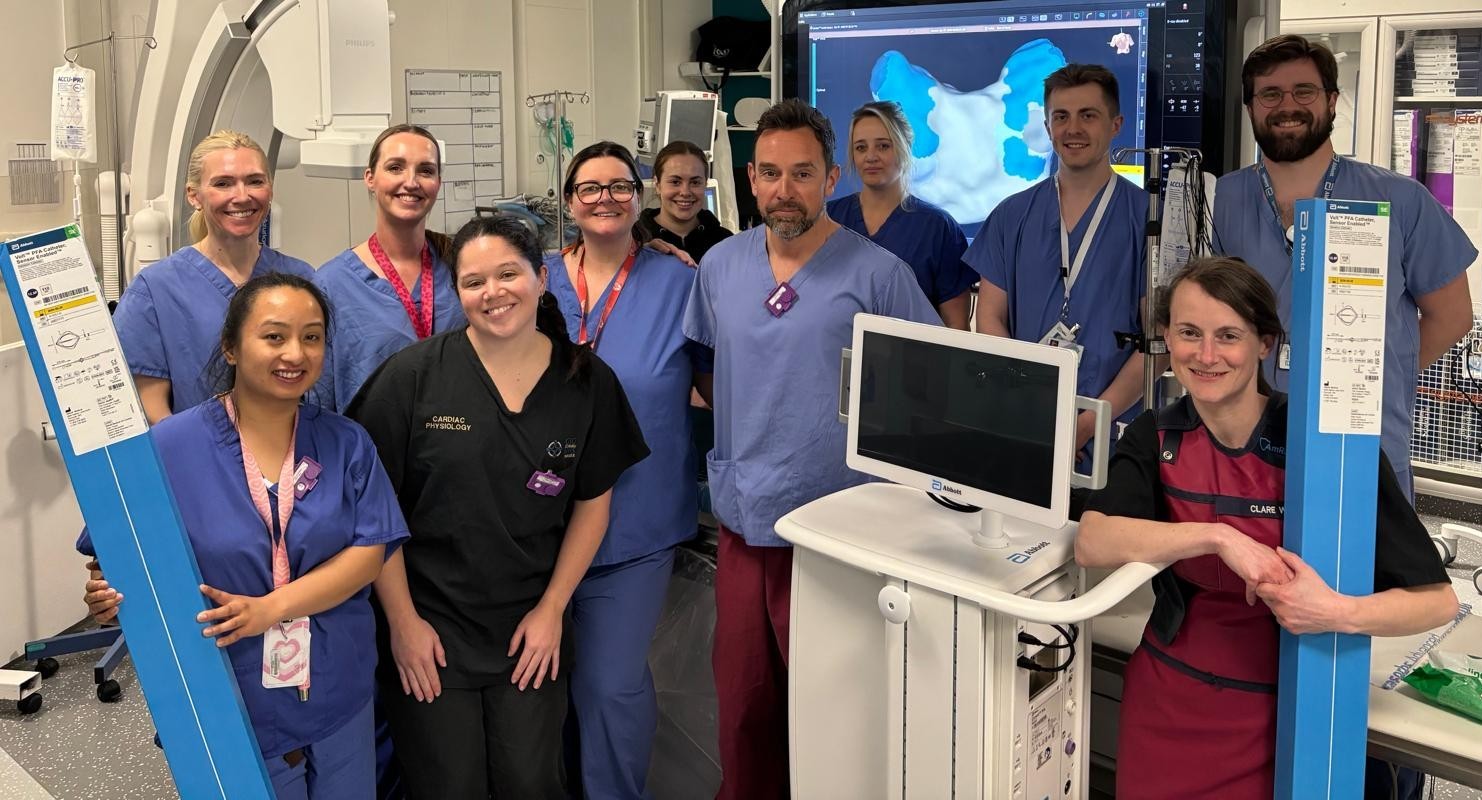
Morriston Hospital’s cardiology team has broken new ground by becoming the first in Wales to treat patients using a revolutionary new technique that destroys malfunctioning heart cells with ultrafast electrical pulses – in a development that could cut waiting times and reduce the risk of complications for thousands of patients with a common heart condition.
The team, led by Consultant Cardiologist and Electrophysiologist Dr Dewi Thomas, successfully treated a patient with Atrial Fibrillation (AF) using a system called Volt Pulsed Field Ablation – a first for Wales and one of the earliest uses of the technology anywhere in the UK.
AF affects around two million people in the UK, causing an irregular and often abnormally fast heart rhythm. Symptoms include fatigue, heart palpitations, breathing difficulties and dizziness – and if left untreated, the condition significantly increases the risk of blood clots, stroke and heart failure.
The Volt system, developed by healthcare company Abbott, uses ultrafast electrical pulses to precisely destroy targeted malfunctioning heart cells. Unlike previous ablation techniques – which used thermal energy to either heat or freeze tissue – the new approach is designed to eliminate the risk of injuring healthy tissue surrounding the heart, representing a significant step forward in both patient safety and procedural efficiency.
Dr Thomas said the procedure had already been performed under general anaesthetic but that future cases could be carried out with patients awake and sedated. “This will result in even shorter procedure times in future, allowing us to treat more patients on an operating list, reducing waiting times for patients and saving money for the health board,” he said.
He described AF as a very common and serious problem, and the Volt system as a powerful new tool. “It won’t completely replace our current approaches to AF ablation, which we’ve been performing very safely and effectively for many years,” he said, “but there are certain patient groups which certainly stand to benefit from this new procedure.”
Dr Thomas added that ablation as a treatment had been refined over more than two decades. “The Volt PFA system represents a milestone in that evolution and we’re really pleased and proud to bring it to Wales, and to be one of the earliest adopters of this technology in the UK.”
The first patient to benefit from the procedure was Glynne Morgan, who lives near Haverfordwest. Mr Morgan had been diagnosed with AF after suffering from chest pains following a bout of flu, and described how his quality of life had deteriorated significantly in the years before his treatment.

He said he had struggled with breathlessness performing even basic tasks and had been unable to do the outdoor activities – cycling, swimming and running – he had previously enjoyed. “I could sleep most of the day,” he said. “I couldn’t do the sort of outdoor things that I used to do, like gardening or cutting the grass.”
Following the procedure, Mr Morgan praised Dr Thomas and his team unreservedly. “From everything under Dr Thomas right throughout his team to the nurses, it was really exceptional,” he said. “It was very straightforward, no pain, and I hope it becomes the standard format for future heart ablations for other heart sufferers.”
He added: “It’s like a weight has been lifted off my chest. I’ve been so much better. My wife’s been walking the dogs for me because I wasn’t even able to do that – she’s glad I can get back to walking them now!”
Swansea Bay University Health Board said it hoped the new procedure would, in time, reduce waiting lists and deliver savings for the health board, as well as improving outcomes for AF patients across the region.

Discover more from Swansea Bay News
Subscribe to get the latest posts sent to your email.







👏👏👏👏👏👏 Dr. Thomas and team. Wow 👌 👏 👏👏👏👏👏👌