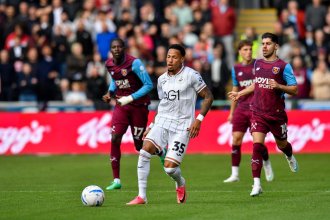
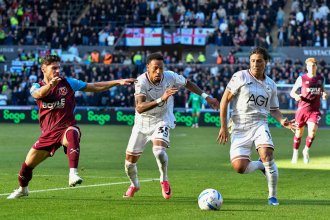
Ross Stewart was left out of Swansea City’s squad for the defeat to West Ham because of the EFL’s homegrown player rules, Vitor Matos has revealed.
The striker was fit, but the Swans were short of homegrown players with Filip Lissah suspended and Josh Key and Cameron Burgess injured.
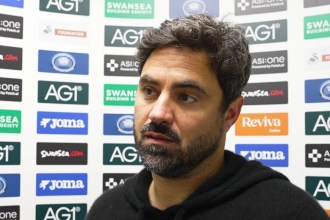
“No, nothing to do with his fitness. It’s a football decision from the situation that we have with the injury of Cam, Key and Fil,” Matos said.
“That is a homegrown situation and just because of that, I don’t know why, but the Scottish players don’t count.”
What the EFL homegrown rule says
Under EFL rules, clubs must name at least seven homegrown players in their 18-man matchday squad.
A homegrown player is one who was registered with a club in England or Wales for three years before his 21st birthday. Nationality doesn’t come into it. It is all about where a player spent his teenage years.
Clubs must also name at least one club-developed player, one who has been with them since before the end of his under-19 season.
A club that cannot meet the homegrown quota has to name a smaller bench.
‘I don’t make the rules’
Matos admitted the rule had caught him out. “Someone explained that to me, but I didn’t know that. Because of that, we needed to make a decision in the short term and that’s the decision I made,” he said.
“I don’t make the rules, so someone did it in that way. But that’s the way it is, so nothing major for him, nothing major for us, but it’s something that the context created and when everything is back, everything is back.”
Ross Stewart: from Ardeer Thistle to the World Cup
Stewart’s route to the top is the reason he doesn’t count.
Born in Irvine in Ayrshire, he spent his late teens in Scottish junior football with Ardeer Thistle and Kilwinning Rangers. Albion Rovers then signed him for £1,500, a fee paid by members of the supporters’ club and his father.
He moved on to St Mirren and Ross County, and did not join an English club until Sunderland signed him in January 2021, when he was 24.
He scored 40 goals in 81 games for Sunderland, moved on to Southampton, and played for Scotland at the World Cup this summer.
None of that counts towards the quota, because he never spent three years at a club in England or Wales before turning 21.
A Chile international and an Ireland international made the cut
The seven homegrown players in Saturday’s squad were Lawrence Vigouroux, Ben Cabango, Josh Tymon, Adam Idah, Andy Fisher, and youngsters Thomas Woodward and Carter Heywood.
Two of them play international football for countries outside Britain. Goalkeeper Vigouroux, who was born in London, has played for Chile. Idah, who joined Norwich from Cork at 16, plays for the Republic of Ireland.
Both qualify because they spent their teenage years at English clubs.
Stephen Welsh, another Scotland international, started at centre-half. He doesn’t count either, having come through at Celtic.
Welsh teenager Woodward took the place on the bench instead of Stewart.
Why the homegrown rule exists
Supporters of the rule say it protects the pathway from academy to first team. Without it, managers could fill their benches with cheaper short-term signings from abroad.
They also argue that regular matchday involvement in a league as tough as the Championship helps young players who could go on to play for England and Wales.
Clubs that develop their own players can spend less in the transfer market and sell them on at a profit later. Fans love seeing “one of our own” in the side, too.
Why critics say the homegrown rule causes problems
Critics say every club is chasing the same pool of eligible players. That pushes up the price and wages of homegrown players who are only average.
They also point to quirks like the one that caught out Stewart. A Scottish, Northern Irish or Irish player who has spent his whole career in Britain still doesn’t count if his early years were spent outside England and Wales.
And, as Swansea found against West Ham, it can force a manager to pick a squad by box-ticking rather than on form or fitness.
Two appearances off the bench since August
Stewart has come off the bench twice since signing on a free in August, against Sheffield United and at Millwall. A quad injury kept him out for a spell in September.
Lissah’s one-match ban has now been served. That should free up a homegrown place for the trip to Queens Park Rangers on Saturday, 24 October (3pm).
Ronald covered at right-back against West Ham, and Matos said he would trust him there again.
Related stories from Swansea Bay News
SWANS: ‘He will perform again’: Matos backs Ronald at right-back after West Ham test
Matos on Ronald at right-back.
SWANS: Scotland World Cup striker Ross Stewart signs three-year deal
Stewart’s arrival in August.
SWANS: Mukasa ends Swansea’s unbeaten home run as West Ham win top-of-the-table clash
The match report.

Discover more from Swansea Bay News
Subscribe to get the latest posts sent to your email.