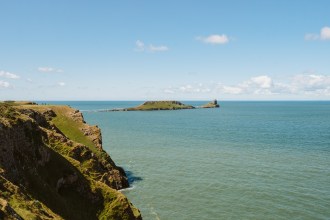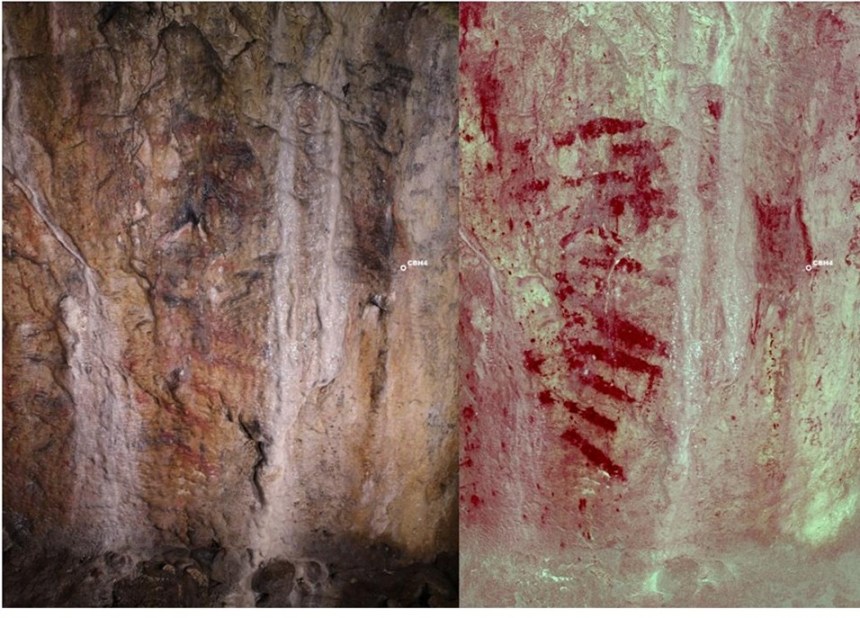
A series of painted marks in a cave on the Gower coast has been confirmed as the oldest known cave art in Britain.
Researchers say the distinct stripes inside Bacon Hole cave, which overlooks the Bristol Channel, were created by human hands around 17,100 years ago.
The cave, cared for by the National Trust in Wales, has long been one of the country’s most significant “bone caves”, named for the ancient animal bones found there.
The painted panel itself was first noted in 1912, but for most of the 20th century it was written off as natural staining rather than the work of people.
New scientific analysis has now overturned that view, confirming the marks as genuine Palaeolithic cave painting.
The findings place Bacon Hole, already a designated Site of Special Scientific Interest, among the most important prehistoric sites in Europe.
The art was made using red iron oxide, a naturally occurring mineral also known as haematite.
An international team carried out the renewed investigation between 2022 and 2024, led by the First Art team from the University of Coimbra in Portugal.
Researchers from Swansea University were involved, alongside colleagues from Southampton, Liverpool and Nanjing Normal University in China.
The team used high-resolution digital photography, uranium-series dating and Raman spectroscopy to examine the age and make-up of the pigments.

All the painted surfaces in the cave were re-examined, confirming the pigment had been deliberately applied by human fingers in lines, dots and splashes.
Dr George Nash, an archaeologist at the University of Liverpool who led the research, said the discovery rewrote what was known about the lives of early Welsh ancestors.
He said the artwork predated all previously identified rock art sites in north-western Europe by at least 1,500 years, making it a find of international significance.
David Thomas, archaeologist for National Trust Cymru, said it was profoundly moving to imagine people standing in the cave more than 17,000 years ago and making their marks on the rock.
He said the trust was grateful to the research team for revealing a hidden chapter of the past on Gower.
The trust has installed a protective metal grille at the cave entrance to safeguard both the fragile archaeology and a rare population of roosting bats.

Because of the cave’s precarious position on the coastal cliffs, it is not safe for the public to visit.
The research was supported by the National Trust and the Bradshaw Foundation, and the full scientific report has now been published.