

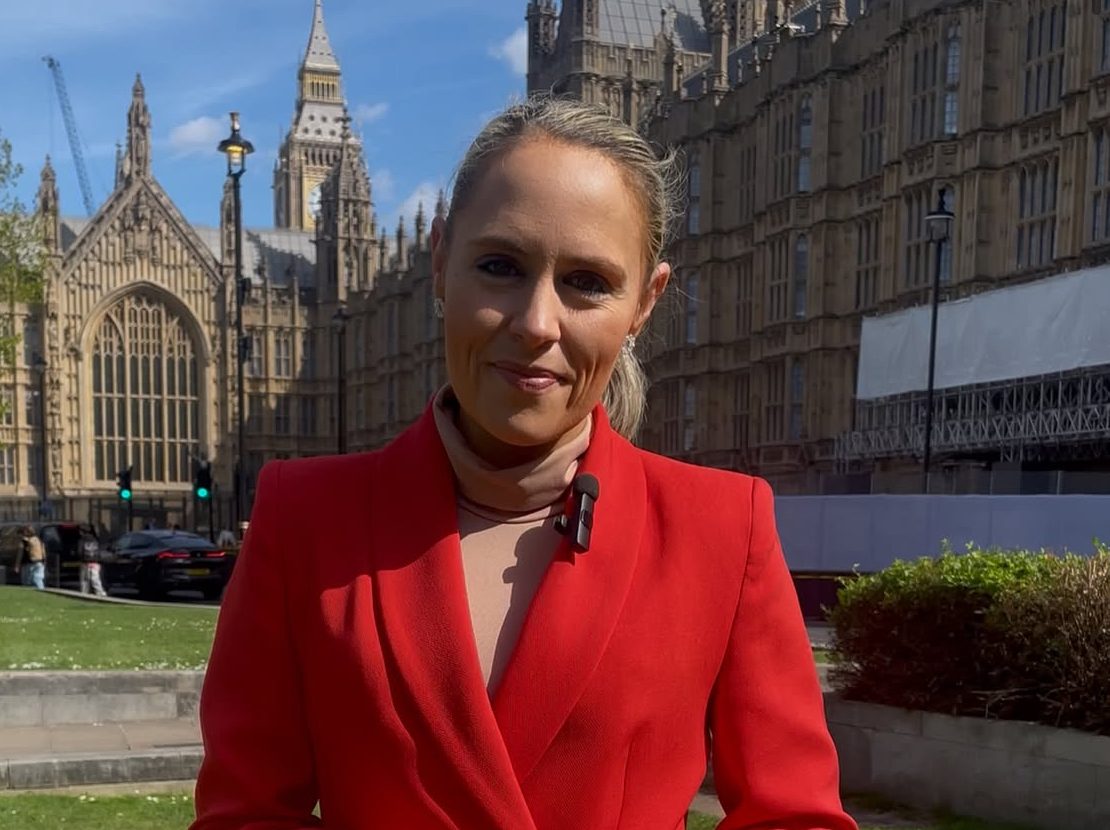
The following is an opinion piece by Kirstie Logan-Townshend, founder of Kirstie Logan Communications and a Swansea-based strategic communications consultant. She previously worked on AI at the Department for Science, Innovation and Technology and holds a Masters degree in Terrorism, Organised Crime and Global Security. The views expressed are her own and do not represent the editorial position of Swansea Bay News. Swansea Bay News publishes OpEds from politicians and public figures across the political spectrum.
It is 7pm on a Tuesday, the warm sticky air of a Swansea evening hanging over the city, and at the top of Townhill a teenage boy retreats to his bedroom and locks the door behind him.
Over in West Cross, a withdrawn fourteen-year-old girl crosses the landing and clicks the lock on her own. Neither set of parents downstairs has any real sense of what those worlds contain.
The Department for Science, Innovation and Technology would very much like to know. It is running a national consultation — “Growing up in the online world” — looking at what more is needed after the Online Safety Act. The question is whether what we end up with is anywhere near equal to the task it has been handed.
It would be easy to think this is somewhere else’s problem. Manchester or Birmingham, the cities we point to. It is not.
From Rhossili to Neath, from Mumbles to Morriston, from the villages tucked into the folds of the Gower to the steep terraces of Townhill, our children are sitting in the same evening light, holding the same devices, exposed to the same risks. The Online Safety Act, as it stands, was set up to fail them too.
I should be transparent about where I come from. I’m a 36-year-old mum from Swansea who worries about the world her daughter will grow up in. I also worked on AI in government when the Online Safety Act was still a bill. My academic background is primarily security-focused, so that’s the lens I bring. I have views.
So let us begin with what we actually mean by online harm. The term has done a great deal of heavy lifting, and very little of it has been precise. Online harm, as the country discusses it, is a soft, parenting-shaped category: screen time and TikTok rabbit holes and difficult conversations at the kitchen table. It conjures a moody teenager scrolling too long, an algorithm tilting attention in unhelpful directions, a parenting failure waiting to be diagnosed. That is not what is happening to our children. What is happening is criminal, organised, and in its most serious forms a matter of national security.
The scale of the threat is this: the National Crime Agency described “Com networks” last year as one of the country’s most urgent emerging threats. These are predominantly teenage boys, using encrypted platforms to share extreme misogynistic and violent material, and coercing girls as young as eleven into self-harm and the production of their own sexual abuse imagery. The threat has grown six-fold in two years.
The NCA is now working jointly with the FBI, because the networks cross borders as easily as they cross the threshold of a children’s bedroom door. This is not a safeguarding conversation. This is organised criminal infrastructure operating at international scale, running through the products of the world’s most profitable companies.
The Online Safety Act reached Royal Assent in October 2023, and by then it had already failed the children it was meant to protect. That government was so preoccupied with positioning the UK as a global AI superpower that it pandered to the tech companies and let them water the legislation down at every stage. “Legal but harmful” came out. The strongest enforcement powers were softened. Our children are paying the price for that choice.
And by that, I mean that government put the problem on parents. Parents working full days, raising families, trying to keep their heads above the cost of everything. That government then instructed parents to set up controls they had not been trained to use, on platforms engineered to defeat them, and declared the result a strategy.
It was about as close to a strategy as padding a pillow with iron filings.
Let me be clear: this is, foremost, a criminal matter, and a national security matter second — the NCA’s National Strategic Assessment places this alongside hostile state actors and serious organised crime. It is also the kind of societal question that shapes the country our children inherit. Parental responsibility comes nowhere near the top of that list.
This is not a call for the state to police ordinary families. What this is, is a call to take the weight off parents conscripted into a job they were never equipped to do, and place it with the public bodies built for exactly this purpose: the NCA and Ofcom. The NCA is good at this work. Ofcom has been handed the powers to be good at this work. They should be properly resourced, empowered, and trusted to get on with it.
The political conditions for serious action are better than they have been. That is not the same as a strategy. The consultation is where the gap closes, or it doesn’t.
The DSIT consultation closes on 26 May. It is a small lever for a problem this big. It is also the only one in front of us right now. What matters is whether the response is bold enough to reset what we inherited rather than tinker, politely, at its edges. Swansea parents should not wait for that fight to be picked for them. Respond before 26 May — search “Growing up in the online world” on gov.uk.
For the boy at the top of Townhill, for the girl in West Cross, and for every child like them in this corner of the country, this consultation is the moment. They are not in their own worlds; they are in worlds built around them, by adults they will never meet, for purposes that have nothing to do with their flourishing. The consultation closing on 26 May is where we decide whether to give them a serious answer.
Kirstie Logan-Townshend is the founder of Kirstie Logan Communications, a Swansea-based strategic communications consultancy. If you would like to submit an OpEd for consideration by Swansea Bay News, please email editor@swanseabaynews.com.

Discover more from Swansea Bay News
Subscribe to get the latest posts sent to your email.