


Wales has woken up to a new political landscape this evening – one in which Plaid Cymru has emerged as the largest party in the Senedd, Reform UK has secured a historic breakthrough, and Welsh Labour has been reduced to nine seats after more than a quarter of a century in power.
The Senedd Election 2026 – the first to be held under the new D’Hondt voting system and with an expanded 96-seat parliament – has reshaped Welsh politics in ways that almost nobody predicted even a year ago.
The final picture, with all 16 constituencies declared, sees Plaid Cymru take 43 seats, Reform UK 34, Welsh Labour 9, the Welsh Conservatives 7, the Greens 2 and the Welsh Liberal Democrats 1.
| Party | Seats | Change |
|---|---|---|
| Plaid Cymru | 41 | +28 |
| Reform UK | 34 | +34 |
| Welsh Labour | 9 | -21 |
| Welsh Conservatives | 7 | -9 |
| Wales Green Party | 2 | +2 |
| Welsh Liberal Democrats | 1 | 0 |
| Total | 96 | +36 |
The most striking individual story of the day was the defeat of First Minister Eluned Morgan in her Ceredigion Penfro constituency – a result that immediately triggered her resignation as Welsh Labour leader.
Morgan became the first ever serving Welsh First Minister to lose her seat at an election, and the first leader of any government in the United Kingdom to lose her seat while in office.
“I take responsibility for the Labour result in Wales,” she told the count from the stage at Ceredigion Penfro. “The age of two-party dominance is dead.”
Wales now faces an immediate Welsh Labour leadership contest and the prospect of a new First Minister – with Plaid Cymru leader Rhun ap Iorwerth, who held his Bangor Conwy Mon seat with ease, the most likely candidate to lead the next Welsh Government.
“It has become clear that Wales has demanded that change of leadership,” ap Iorwerth said after his re-election. “Plaid Cymru is ready to serve.”
The election produced a record turnout for a Senedd election – 51.65% across Wales, the first time the 50% benchmark has ever been broken at a Welsh parliamentary election.
That turnout had been forecast as a positive indicator for Reform UK, which had focused much of its campaign on mobilising voters who had not traditionally turned out at Welsh elections.
The forecast proved correct. Reform UK topped the poll in four constituencies – Casnewydd Islwyn, Brycheiniog Tawe Nedd, Sir Fynwy Torfaen and Clwyd – and won three seats in three more.
Welsh leader Dan Thomas, who became an MS himself after winning a seat in Casnewydd Islwyn, called Reform “the people’s army” of Welsh politics.
“In just five years, Reform has gone from winning 1% of the vote in the Senedd elections to being the main contender for government, smashing Labour in the process,” Thomas said.
For Plaid Cymru, the election represents a remarkable consolidation of support. The party topped the poll in 11 of the 16 constituencies and took three seats in nine of them – including a clean sweep of four seats in Gwynedd Maldwyn.
Among those returning to the Senedd for Plaid is former leader Adam Price, who was elected in Sir Gaerfyrddin from third place on his party’s list – itself a sign of how strongly Plaid performed in the constituency.
The constituency-by-constituency breakdown shows just how starkly the political map of Wales has been redrawn.
| Constituency | Plaid | Reform | Lab | Con | Other |
|---|---|---|---|---|---|
| Casnewydd Islwyn | 2 | 2 | 1 | 1 | – |
| Pen-y-bont Bro Morgannwg | 2 | 2 | 1 | 1 | – |
| Caerdydd Penarth | 3 | 1 | 1 | 0 | 1 (Grn) |
| Blaenau Gwent Caerffili Rhymni | 3 | 3 | 0 | 0 | – |
| Sir Gaerfyrddin | 3 | 3 | 0 | 0 | – |
| Pontypridd Cynon Merthyr | 3 | 2 | 1 | 0 | – |
| Afan Ogwr Rhondda | 3 | 2 | 1 | 0 | – |
| Sir Fynwy Torfaen | 2 | 2 | 1 | 1 | – |
| Bangor Conwy Mon | 3 | 2 | 0 | 1 | – |
| Caerdydd Ffynnon Taf | 3 | 1 | 1 | 0 | 1 (Grn) |
| Brycheiniog Tawe Nedd | 2 | 3 | 0 | 0 | 1 (LD) |
| Ceredigion Penfro | 3 | 2 | 0 | 1 | – |
| Gwyr Abertawe | 3 | 2 | 1 | 0 | – |
| Clwyd | 2 | 3 | 0 | 1 | – |
| Gwynedd Maldwyn | 4 | 2 | 0 | 0 | – |
| Fflint Wrecsam | 2 | 2 | 1 | 1 | – |
| Total | 41 | 34 | 9 | 7 | 3 |
For Welsh Labour, the result is bleak. The party has been wiped out entirely in six constituencies – Sir Gaerfyrddin, Blaenau Gwent Caerffili Rhymni, Brycheiniog Tawe Nedd, Ceredigion Penfro, Clwyd and Gwynedd Maldwyn – and reduced to a single seat in most others.
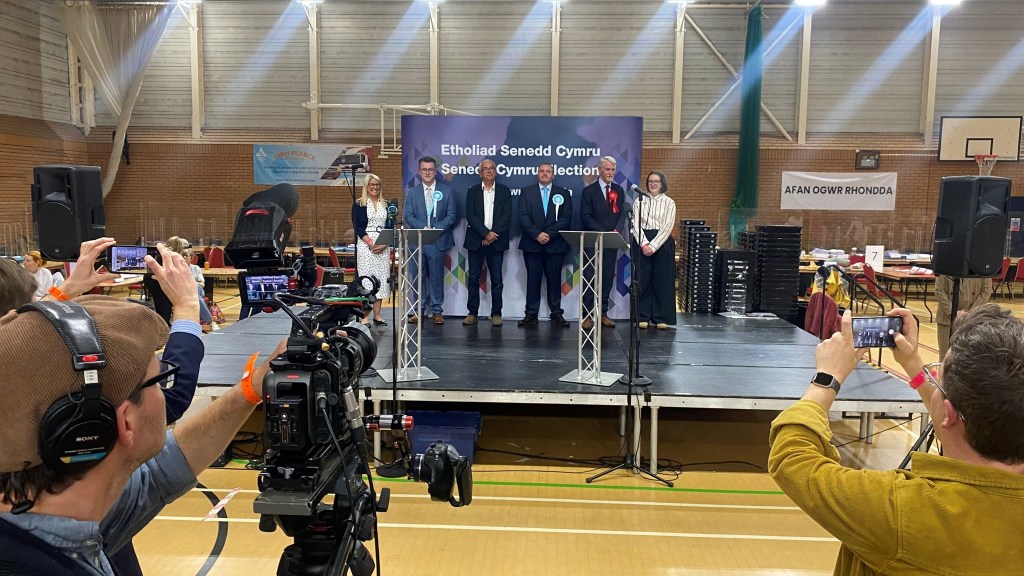
Welsh Labour’s nine surviving Members of the Senedd are dominated by senior figures. Cabinet members Huw Irranca-Davies (Deputy First Minister), Sarah Murphy (Deputy Minister for Mental Health and Wellbeing), Lynne Neagle and Ken Skates (Transport) all held their seats. Mike Hedges was returned in Gwyr Abertawe and Jayne Bryant in Casnewydd Islwyn.
(Image: Neath Port Talbot Council)
The defeat of First Minister Eluned Morgan, however, is the headline loss – and brings to an end a century-long run of Welsh Labour electoral dominance dating back to 1922.
Welsh Labour’s collapse was particularly stark across south-west Wales. The party was wiped out entirely in Sir Gaerfyrddin and Brycheiniog Tawe Nedd, reduced to one seat in Gwyr Abertawe and Afan Ogwr Rhondda, and lost its First Minister in neighbouring Ceredigion Penfro.
Speaking after Mike Hedges’ re-election as the only Welsh Labour MS for Swansea, Council leader Rob Stewart – who was Labour’s number two on the Gwyr Abertawe list and was not elected – acknowledged the difficulty of the result.
“Obviously, this is not the result we worked for,” Stewart said. “Nationally, it has been a really difficult night for Welsh Labour and UK Labour.”
Stewart said the threat of Reform UK had loomed over the campaign. “Clearly the threat of Reform has been at the forefront of many voters’ minds, and we heard on the door that when people could not give us their vote this time, they didn’t want to go to Reform and have clearly opted for Plaid Cymru,” he said.
The Welsh Conservatives have ended the day with seven seats – a smaller party than at the last Senedd, but with three of their leaders past and present returned. Andrew RT Davies, the former Welsh Conservative leader, was re-elected in Pen-y-bont Bro Morgannwg. Current leader Darren Millar held his seat in Clwyd. And former Welsh Conservative Senedd leader Paul Davies returned to the Senedd via Ceredigion Penfro.
Conservative Senedd colleague Samuel Kurtz failed to be re-elected.
The Greens secured two seats in Wales for the first time – both in Cardiff. Anthony Slaughter, the party’s Welsh leader, took his seat in Caerdydd Penarth and called it a “historic breakthrough” for the Greens in Wales.
The Welsh Liberal Democrats secured a single seat – that of leader Jane Dodds, who held on in Brycheiniog Tawe Nedd. The party had hoped for a stronger result but its presence in the Senedd is preserved.
What now follows is coalition politics on a scale Wales has not seen since devolution began.
With 49 seats needed for an overall majority, Plaid Cymru is eight short of governing alone. Polling expert Sir John Curtice had projected the party would win between 41 and 46 seats – the final figure of 41 sits at the lower end of that projection.
The arithmetic of the new Senedd makes a Plaid Cymru-led coalition almost certain – but the question is who Plaid will choose to govern with.
A formal coalition with Welsh Labour would deliver a stable majority of 50 seats – though the politics of bringing the heavily defeated party of government into a new coalition would be difficult.
A confidence-and-supply arrangement with the Welsh Lib Dems and Greens would still leave Plaid three seats short of a majority, requiring further support from other parties.
A coalition with Reform UK would command a vast majority of 75 seats – but is politically inconceivable, with Reform’s positions on devolution and Welsh public services fundamentally at odds with Plaid’s.
The most likely outcome, observers suggest, is a Plaid-led minority government supported on a confidence-and-supply basis by smaller parties – or a formal coalition with Welsh Labour rebuilding from the wreckage of today’s result.
Either way, the next First Minister of Wales is very likely to be Plaid Cymru’s Rhun ap Iorwerth – a fundamental shift in Welsh political leadership for the first time since devolution began in 1999.
The election also marks Wales’ political landscape becoming significantly more fragmented. The new Senedd has six different parties represented – up from four after the 2021 election – reflecting both the new electoral system and the political reorientation that has taken place.
Welsh political expert Professor Laura McAllister told BBC Wales that Eluned Morgan had been dealt an impossible hand. “The odds were stacked so hard against her, she didn’t get an ounce of help from her UK party, or the Prime Minister,” she said.
Prime Minister Sir Keir Starmer paid tribute to Morgan in a statement issued shortly after her defeat, calling her “a formidable First Minister and tireless champion for Wales” – though earlier in the day senior Welsh Labour figures had called for him to consider his own position over the scale of the party’s Welsh defeat.
The new Senedd will sit for the first time in the coming weeks, when its 96 Members of the Senedd will be sworn in and the process of forming the next Welsh Government will formally begin.
For now, however, the picture is clear. Wales has rejected its long-time governing party, embraced a populist insurgency, and elevated a nationalist alternative to the largest party in its parliament for the first time in history.
The age of two-party dominance, as Eluned Morgan said in her resignation speech, is dead. What replaces it begins now.

Discover more from Swansea Bay News
Subscribe to get the latest posts sent to your email.