

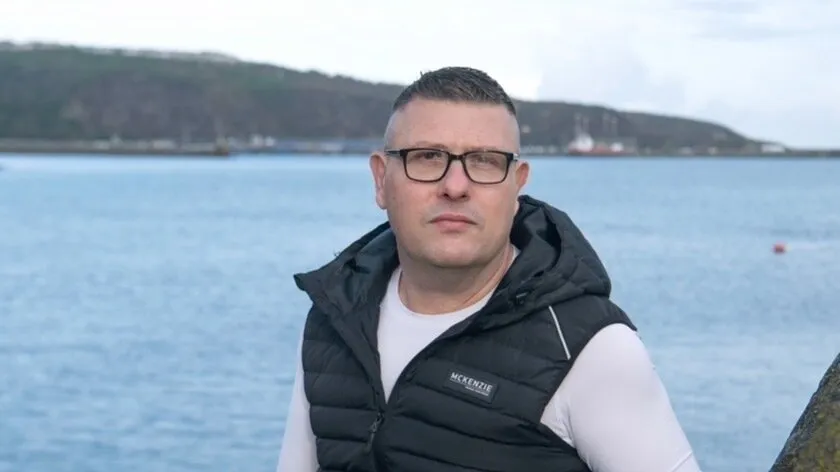
A Fishguard man who spent more than five years in prison before being cleared of every charge against him has had his claim for compensation rejected for a second time.
Brian Buckle told BBC News he felt “sick” on learning the Ministry of Justice had turned down his claim again, despite a review prompted by the intervention of a justice minister.
Mr Buckle was convicted in 2017 and sentenced to 15 years. He has always maintained he was, in his own words, “set up by the child’s real abuser to take the blame” — and that he did not have the evidence to prove it the first time around.
After a five-year legal fight funded by his family, the Court of Appeal found the conviction unsafe in 2022 — granting him bail the same day, after five years and four months inside. “My family drove straight from the Royal Courts of Justice to bring me home,” he has written.
At his retrial at Swansea Crown Court — in the same courtroom, before the same judge and with the same prosecutor — a jury heard new forensic evidence and witnesses before taking less than an hour to clear him on all 16 counts.
Proving his innocence cost him and his family £500,000 — much of it funded by his father-in-law, who sold his house to pay for the fight and died shortly before the retrial. “Without his generosity and unwavering faith in my innocence I would without any doubt still be sitting in a prison cell,” Mr Buckle has written.
“My wife’s inheritance has been spent, and I lost a well-paid job that I had done for 16 years prior to my arrest,” he says. “I missed my daughter’s 18th and 21st birthdays and so much more.”
The MoJ’s rejection letter in April said his claim did not meet the statutory test — while adding that the decision “does not affect the fact that Mr Buckle’s conviction was quashed, nor does it cast doubt on the outcome of the appeal”.
Mr Buckle told the BBC the ordeal had left him with post-traumatic stress disorder. “As a family it’s been really hard, it’s the most horrendous thing I’ve ever had to go through,” he said.
His MP, Ben Lake — the Plaid Cymru member for Ceredigion Preseli — told Swansea Bay News the decision “beggars belief”, coming almost a year after Sir Keir Starmer, while prime minister, described the case in the Commons as a “grave miscarriage of justice”.
Mr Lake said the refusal “calls into question the value of statements made by senior government officials in the House of Commons, and will do little to restore faith in politics.”
He said it underlined “the flawed nature of a compensation scheme that will not award a victim of a miscarriage of justice a penny in compensation even after they have spent more than five years in prison for crimes of which a jury of their peers has found them to be not guilty.”
The Ceredigion Preseli MP said the state had “a moral responsibility to compensate those that it falsely imprisons”, calling it “an injustice that I will not allow to stand”.
And he pledged to keep up the pressure at Westminster: “Members of Parliament are sent to Parliament to right the wrongs inflicted upon their constituents, and if I am required to secure a dozen more parliamentary debates and questions to government ministers so that Mr Buckle receives justice, so be it.”
At the heart of the refusal is a change in the law made in 2014. Before then, compensation was paid where it was shown no reasonable jury could have convicted on the evidence — a test Mr Buckle’s retrial would appear to have met.
Since 2014, claimants must effectively prove they did not commit the crime. His barrister, Stephen Vullo KC, told the BBC that was impossible in a case with no DNA or CCTV evidence — and claimed the law was working as intended: “If you were to ask me to draft a piece of legislation that would ensure that almost everybody was turned down for compensation, I’d draft something similar.”
On the family’s petition, Mr Vullo goes further — writing that demanding more than a quashed conviction and a jury acquittal “places the bar so high that hardly anyone will be able to jump it”, and that the ministry’s refusal letter “is riddled with errors but ends by stating there is no appeal against their decision”.
He argues the scheme should be scrapped in favour of automatic payouts in cases like Mr Buckle’s — or, failing that, that the decision should rest with the jury that heard the case: “Brian’s jury heard all of the evidence and are the best placed to decide where justice and fairness lies.”
An MoJ impact assessment at the time of the change said its intended effect was to lessen the burden on taxpayers.
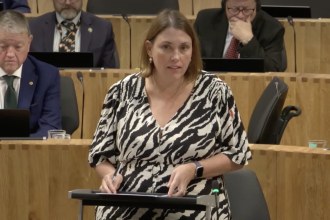
The effect has been stark: government figures show around 93% of compensation applications have been rejected since 2016. In a Westminster Hall debate on the case secured by Mr Lake, the then justice minister Alex Davies-Jones said that of 591 applications received between April 2018 and April 2024, just 39 people were awarded a share of £2.4m.
The issue reaches well beyond west Wales. Andrew Malkinson, cleared by DNA evidence after 17 years in prison, was left destitute waiting for a payout and has called the system “not fit for purpose” — while victims of the Post Office Horizon scandal, including in Swansea, needed four separate bespoke compensation schemes because the standard scheme would have rejected them too.
A petition started by his wife Elaine calling for the scheme to be scrapped or reformed has gathered more than 41,700 verified signatures. On its page, Mr Buckle quotes the ministry’s own refusal letter telling him: “You are presumed to be and remain innocent of the charges brought against you” — words that came alongside a decision to pay him nothing.
“I am not seeking millions,” he writes — noting that even a full award “would not come close to covering the costs of my legal fees or even my lost wages”. “I do believe I should be compensated — not for financial gain but to have the injustice I have experienced acknowledged.”
The Law Commission proposed in February 2025 that the 2014 test be reversed, so the wrongly convicted need only prove innocence on the balance of probabilities. It has now prioritised the compensation section of its criminal appeals review, due to be published at the end of this year.
Mr Buckle hopes any change would apply retrospectively — to him, and to others in the same position.
Ms Davies-Jones, who intervened in Mr Buckle’s case while a justice minister, said she was deeply sorry his application had been unsuccessful again and recognised wider questions about the scheme.
The MoJ said it acknowledged the grave impact of miscarriages of justice and would consider the Law Commission’s findings before deciding on any action.

Discover more from Swansea Bay News
Subscribe to get the latest posts sent to your email.