The company that ran the fuel train that derailed and burned at Llangennech in 2020 says a signaller could have stopped it before it came off the rails. It is suing Network Rail for more than £30m.
DB Cargo UK was itself taken to the High Court by Network Rail in August. The rail body wants more than £5m from the operator and from the wagon’s owner, Touax Rail.
Both companies have now filed their defences, according to court documents reported by the Press Association. DB Cargo denies any blame, and has answered with a counterclaim six times the size of the one it faces.
Its case turns on what happened as the train passed a signaller on its way towards Morlais Junction. DB Cargo argues the signaller failed to watch the train properly, and that anyone paying attention would have heard metal grinding on metal or seen sparks coming from the wagon whose wheels had locked.
Isabel Hitching KC, for DB Cargo, says the signaller should have contacted the driver at once. Had that happened, her written case says, “the train would have been brought to a safe stop, and the derailment would not have occurred”.
The £30m includes more than £24.5m DB Cargo says it spent on the emergency response and the clean-up that followed. Natural Resources Wales said in 2023 that the specialist contractors who dug out the site had been working for DB Cargo and its insurers.
DB Cargo also says Network Rail is wrong to pin the wagon’s upkeep on the operator. It did not and could not control how Touax maintained the vehicle, its defence says.
Touax says it never worked on the wagon’s brakes
Touax, the wagon-leasing firm that owned the vehicle, denies liability in full. Its barrister Gerard Rothschild says the company “at no material time” carried out any direct maintenance of the wagon’s brakes.
Its defence blames negligence by several other parties involved in running and maintaining the train and the railway, naming DB Cargo and Network Rail among them, and says the derailment would not have happened had Network Rail taken reasonable care.
If a judge does find against Touax, it will ask for any damages to be cut to reflect what it calls Network Rail’s own contributory negligence.
Each company has also issued a separate legal claim of its own over the derailment, and both have asked for those to be heard alongside Network Rail’s. No hearing date has been set.
Network Rail’s own case, filed in August, is that Touax failed to maintain the wagon with reasonable care and that DB Cargo broke a contractual duty to make sure that care was taken. Its lawyers put the loss at more than £5m.
The RAIB traced a locked wheel to the brakes, and asked for better warnings to signallers
The Rail Accident Investigation Branch took 16 months over the crash. Its findings, published in January 2022, were that one set of wheels on the third wagon had stopped turning during the journey, most likely because of a brake defect it traced to deficiencies in the design and maintenance of components.
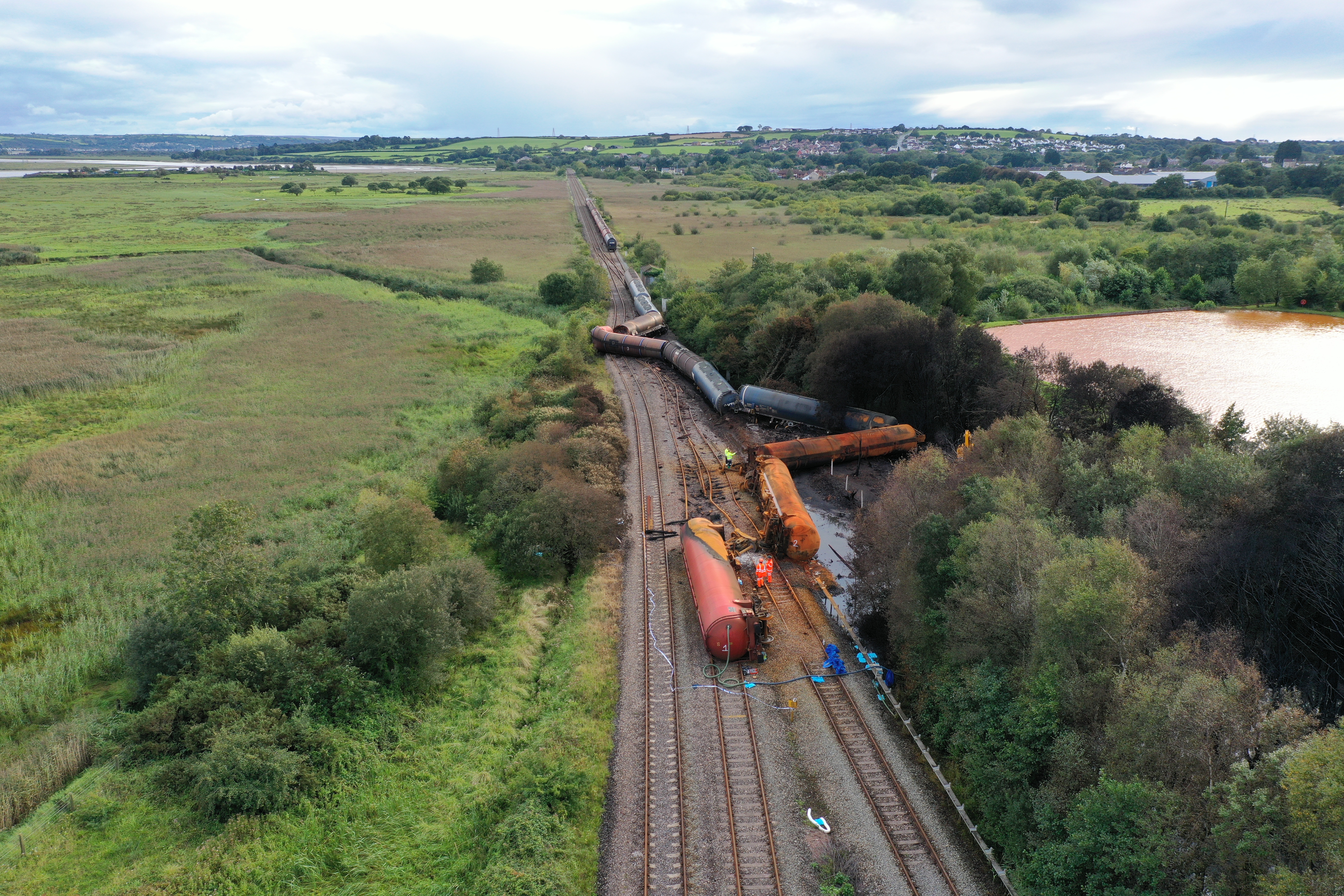
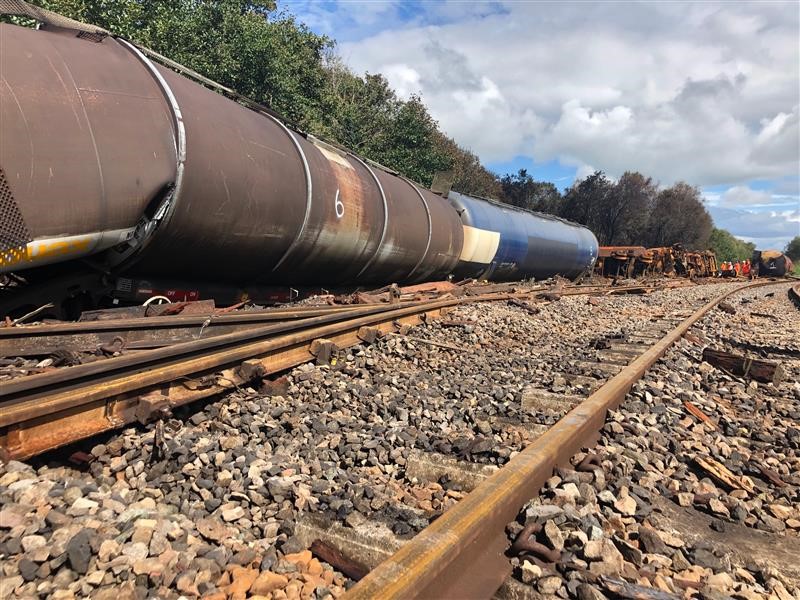
The locked wheels slid along the rail, wearing flats into the treads, until they could no longer get through the pointwork at Morlais Junction. The third wagon came off, and the nine behind it followed on the broken track.
The RAIB does not assign blame or liability. Among its nine recommendations, though, was a review of the technology and systems used to warn train crew, signallers and control rooms about wagon defects that could lead to a derailment, the same ground DB Cargo’s counterclaim now covers.
Simon French, the chief inspector of rail accidents, said at the time: “The rail industry’s approach to the safe maintenance of freight wagons needs to improve.” He said his investigators had found inadequate maintenance practices and a failure to grasp how important it was to fasten the brake components correctly.
446,000 litres of fuel, 300 people out of their homes and seven weeks without cockles
The train left Milford Haven for Theale, near Reading, on 26 August 2020 with 25 tankers of fuel behind it. At 11.04pm, ten of them left the rails at Morlais Junction.
Some of the tankers ruptured and the fuel caught. Around 300 people were moved out of their homes as the fire took hold, and firefighters were still there the best part of two days later.
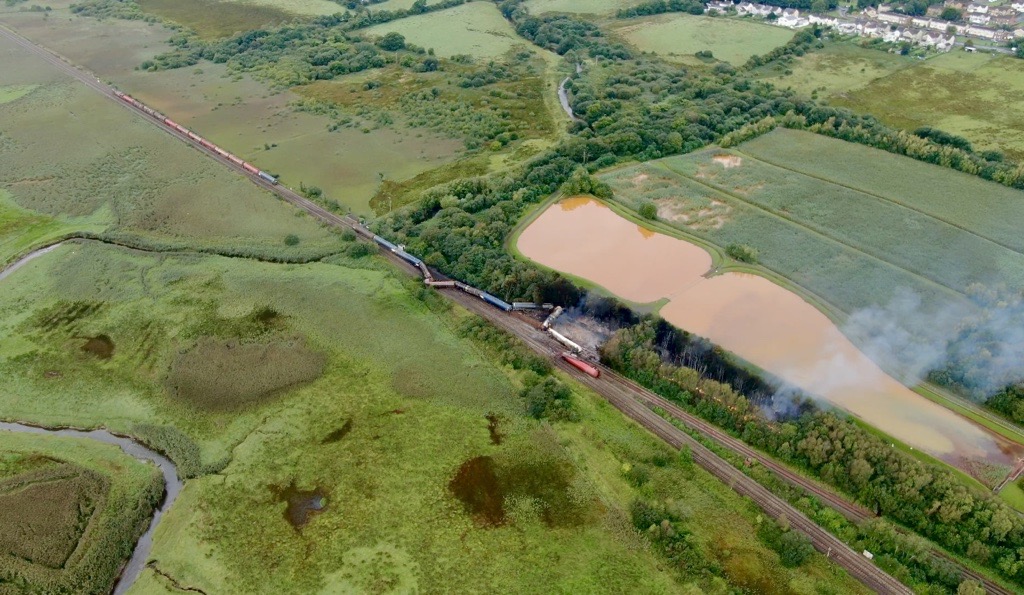
The RAIB put the spill at 446,000 litres. The fuel ran into the wetlands, mudflats and cockle beds of the Loughor estuary, a site of special scientific interest and a special area of conservation, and the shellfisheries were shut for seven weeks on Food Standards Agency advice.
Getting it out meant digging 30,000 tonnes of fuel-soaked soil from beneath more than 150 metres of track, in what the recovery manager called the hardest operation since the Sea Empress. The line reopened in March 2021 on 530 metres of new track, after more than six months shut.

Nobody has ever been prosecuted. Natural Resources Wales dropped its criminal investigation in February 2023, with its head of south west operations, Martyn Evans, saying it had “not been possible to determine beyond reasonable doubt who was ultimately responsible”.

A civil claim is decided on the balance of probabilities, a lower bar than a criminal case. Three companies now each say the fault lies elsewhere, and the High Court will have to decide between them.

Discover more from Swansea Bay News
Subscribe to get the latest posts sent to your email.