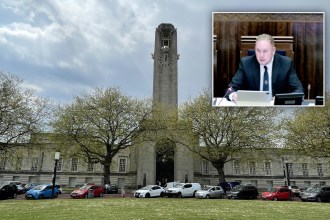



Carmarthenshire households have been warned council tax could go up by double digits next year, with the council’s own finance chiefs saying they cannot yet see how to balance the books.
The budget outlook going to Carmarthenshire Council‘s cabinet on Monday puts the gap over the next three years at more than £32m. Against that, the council has found £10m of savings.
For 2027/28 alone, even on what the report calls “more optimistic assumptions”, the council needs £13m of budget reductions plus a 5% council tax rise to break even. Its current savings proposals, it admits, “fall well short of this”.
Then comes the warning. If the county’s schools cannot get their spending under control, the report says the outlook is “under significant risk”, and the answer will be “radical service reductions in other areas” or “double digit increases in council tax”. The schools are already forecast to be £16m in deficit by March.
What’s on the table
The report lists what councillors may have to consider: dropping some discretionary services altogether, cutting the “frequency, standard or locations” of statutory ones, reducing staff numbers across a number of services, and the straight trade-off between council tax and protecting services.
It puts numbers on the risks. Every 1% the Welsh Government gives less than assumed costs £4m, or 4% on council tax. A pay award 1% higher than budgeted is £3m, or 3%. If service pressures run at last year’s level rather than the £10m allowed, that is another £5m, or 5%.
Why the sums have moved
Energy is the new line. The report says global energy costs have been “exceptionally volatile” since the start of the Iran War, and the council is now budgeting for a 10% rise in gas and electricity and a 25% rise in fleet fuel, together £1.6m it had assumed would be zero. Bunkered fuel for the bin lorries and gritters has no forward contract at all.
Inflation is running above the 2% the council planned on. It has moved its assumption to 3.2% after the Bank of England published three separate forecasts depending on how the war plays out.
Pay is unsettled. Council staff have been offered 3.3% and all three unions have rejected it. Teachers have been given 3.5%, in line with the budget, but two unions have declared a dispute with the Welsh Government over it.
The one piece of good news is teachers’ pensions: the employer contribution drops from 28.68% to 17.68%, which the report says will “materially reduce costs in schools”. The council assumes the money will be clawed back through the funding settlement, so it is counting it as neutral.
The Cardiff and Westminster problem
The report is blunt about the politics. It notes the UK has had “7 Prime Ministers in 10 years” and that the new Plaid finance minister, Elin Jones, said in June the Welsh Government’s finances were “more challenging” than she expected. With Plaid’s manifesto money earmarked for free childcare and secondary school meals, the council expects settlements for core services to be “just as difficult” as recent years.
It is assuming Welsh Government funding rises 3.2% and flags that as “a significant risk”. The provisional settlement is due in late November, after the UK Autumn Budget on 28 October.
Council tax already leans on second homes: premiums of up to 100% on empty and second homes are in the figures and, the report says, “helped to balance the overall corporate budget”. Council tax reform, due in 2028, is now being “actively looked at” by ministers.
In January the council consulted on a 6.5% rise for this year and settled on 4.9%. The draft budget for next year goes to cabinet on 14 December, with public consultation and councillor seminars in January before the final vote in the spring.
Monday’s reports are presented by resources cabinet member Cllr Alun Lenny, and cabinet is asked to decide what level of council tax rise and what scale of cuts it thinks appropriate before the detailed work starts.

Discover more from Swansea Bay News
Subscribe to get the latest posts sent to your email.