The UK average price paid to dairy farmers for their milk fell 16.3% between August 2025 and August 2026, according to the Farmers’ Union of Wales.
The union says nearly half of all milk produced in Wales is processed outside Wales. Its deputy president Dai Miles, an organic dairy farmer and founder member of the Calon Wen co-operative, believes processing more of it here would create jobs and keep more of its value in rural communities.
He is making the case for a long-term dairy strategy at a union event at the showground in Carmarthen tonight. The Welsh Dairy Show is held there tomorrow (Tuesday 20 October).
Mr Miles says technology has already cut farmers’ costs, but there is a limit. “We cannot simply expect farmers to become more efficient indefinitely to compensate for every increase in costs or every fall in milk price,” he said.
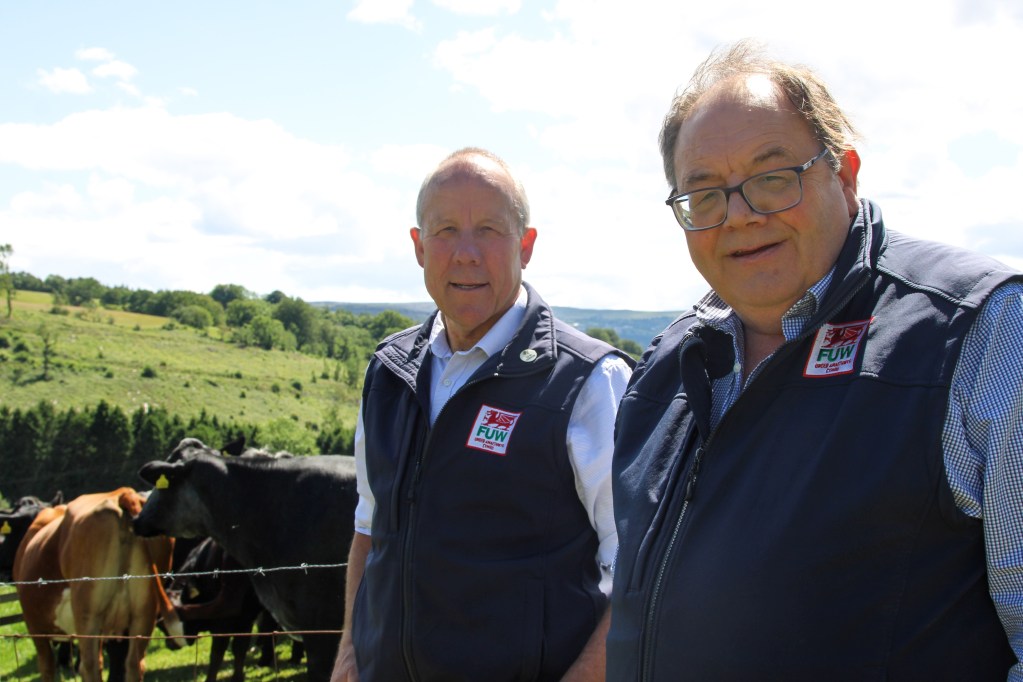
Llangadog family lost their entire dairy herd to TB in 2016
The union’s case in point is Godregarreg in Llangadog. It is hosting a farm visit there today with Eifion, Ann, Aaron and Ioan Hughes.
In 2016 the family lost their entire dairy herd to bovine TB. They rebuilt with 88 Fleckvieh cattle imported from Austria, crossed with Friesians for more milk.
Today the herd stands at 140, and its milk goes to Leprino to be made into mozzarella.
But after 80 years of milking at Godregarreg, the FUW says TB, changing regulations, volatile milk prices and rising costs mean the family’s future plans are unlikely to include a bigger dairy.
32,000 hens and solar panels on a Llangadog dairy farm
Eifion’s grandfather John Hughes moved to Godregarreg from Cwmbran, Myddfai in 1936. The farm has grown from 28 acres to 400, with another 120 rented.
Looking for other income, the family added free-range eggs in 2018. There is room for 32,000 Shaver hens, supplying Cornish firm St Ewe, whose customers include M&S, Tesco, Ocado and Morrisons.
Solar panels went on the dairy in 2011, and a larger 49.8kW array came with the egg unit, feeding spare power into the National Grid. This year the family won the Royal Countryside Fund Family Farm Award at the M&S Select Farm Awards, held during the Royal Welsh Show.
Hottest summer on record and Bluetongue jabs add to a tough year for dairy farmers
The FUW says the hottest summer on record forced many farmers to feed their cattle fodder meant for winter. At the same time costs kept rising, including Bluetongue vaccination.
Last December the union held an emergency meeting over collapsing milk prices. It warned then that some farmers were being paid far below what it cost them to produce their milk.
Mr Miles says farmers need prices they can plan around. “We need a supply chain that recognises the investment, skill and risk involved in producing milk, and a pricing system that gives farmers greater confidence to plan for the future,” he said.
1.8 billion litres a year: should Welsh milk count as critical national infrastructure?
The FUW says Wales produces around 1.8 billion litres of milk a year, and puts the value of what is made from it at more than £900m annually.
Mr Miles says the industry’s reach goes well beyond the farm. “Wales is punching way above its weight compared to the rest of the UK when it comes to milk production and its economic and social contribution goes well beyond the farm gate,” he said.
He listed who depends on it, from vets and hauliers to the Welsh language. “Dairy production supports processing businesses, agricultural contractors, feed merchants, machinery dealers, vets, hauliers and retailers, it sustains family businesses, the Welsh language and culture; indeed it is integral to the very fabric of rural Wales.”
He went further. “With 99.6% of British households buying dairy products, it could be argued that the sector should be recognised as critical national infrastructure,” he said.
Where does Welsh dairy want to be in 20 years?
The union has welcomed the Welsh Government’s National Food Strategy as a step towards long-term investment in Welsh food. The dairy call follows the joined-up Welsh food system the FUW demanded in its 2026 manifesto before May’s Senedd election.
Mr Miles wants the industry to look past this year’s price falls. “And we need to look beyond the immediate challenges of price falls and cost increases and ask, where do we want the industry to be in ten or twenty years time?” he said.

Discover more from Swansea Bay News
Subscribe to get the latest posts sent to your email.