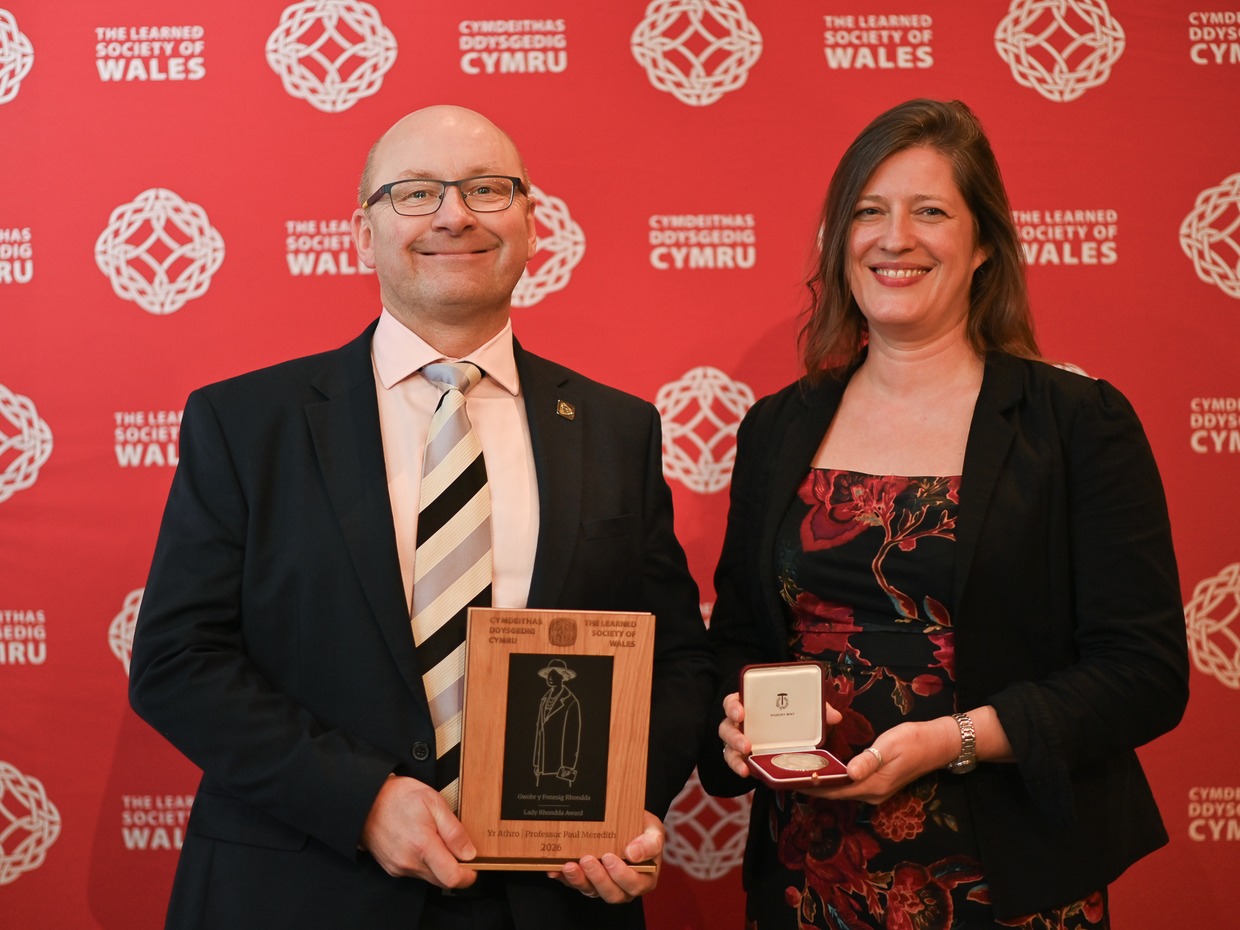
The Swansea academic who works on the diaries of Amy Dillwyn, and the physicist who came home to run the city’s semiconductor centre, have each won a national medal that has never been given before.
Professor Kirsti Bohata and Professor Paul Meredith, both of Swansea University, were honoured by the Learned Society of Wales.
She received the Gwen John Medal for Arts and Humanities. He was given the Lady Rhondda Award for Outstanding Achievement.
Both are being handed out for the first time, in a relaunched set of honours named after Welsh pioneers.
Kirsti Bohata and the diaries of Amy Dillwyn
Prof Bohata runs the university’s Centre for Research into the English Literature and Language of Wales, and her own work includes Dillwyn’s diaries.
Dillwyn was born in Sketty in 1845 and wrote six novels. She took over the family metalworks in Llansamlet after her father died, and the park beside the Arena carries her name.
The medal also recognises Prof Bohata’s research on LGBTQ+ literature in Wales and her part in setting up the Wales Arts and Humanities Alliance.
Prof Bohata said: “It is an honour to be nominated for this medal. I am standing on the shoulders of giants.”
She added: “In my own research in literature, I have been blessed by fantastic mentors and generous collaborators in Swansea University, across Welsh writing in English and beyond. Diolch o galon i chi gyd.”
Paul Meredith, back at the Swansea physics department where he started
Prof Meredith is director of the Centre for Integrative Semiconductor Materials at the Bay Campus. Semiconductors are the chips inside phones, cars and medical equipment.
He also leads the national doctoral training centre for the industry, which launched in January with £18m to train up to 60 PhD students.
Born, raised and educated in Wales, he set up three start-up companies in Australia and worked on renewable energy policy in Queensland before coming back.
Prof Meredith said: “My career has taken me all around the world, but I’m delighted to be back exactly where I started at Swansea University Physics, my home department.”
He said the medal had “particular significance” for someone “born, bred and educated in south Wales”, because it honoured Lady Rhondda.
He added: “Scientific research is a collective endeavour, and I’m delighted to accept the Medal on behalf of all those colleagues and students I have collaborated with here in south Wales and across the globe.”

Discover more from Swansea Bay News
Subscribe to get the latest posts sent to your email.