

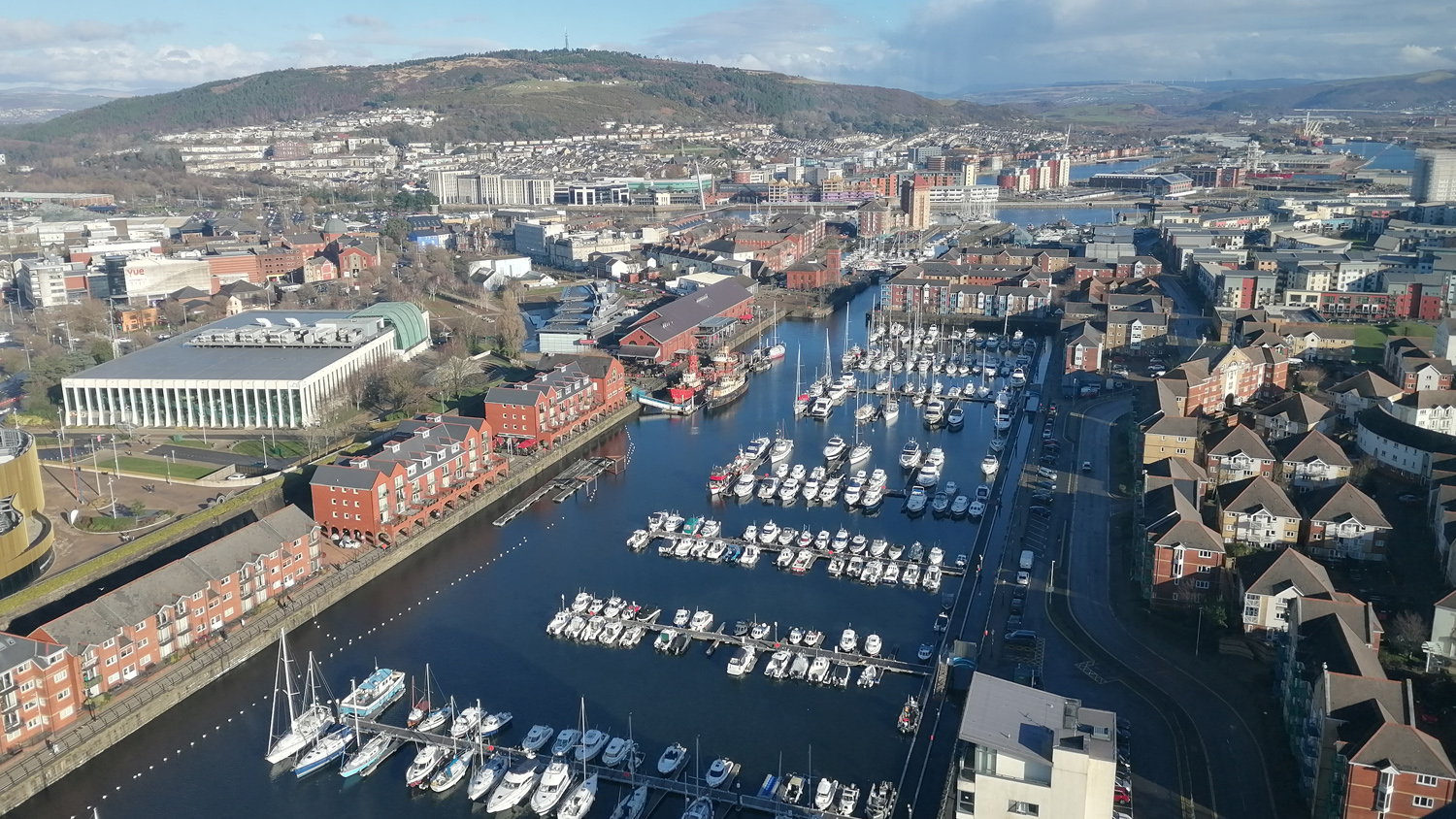
The report behind the proposed Swansea to south-west England ferry has been published in full for the first time — and it is heading straight for a council scrutiny panel.
The OceanJet Line consultation report, funded by Swansea Council through a £24,999.95 Shared Prosperity Fund grant, was released as an appendix to Thursday’s full council papers.
It sets out an ambitious vision: hydrogen-electric vessels with a target top speed of 60 knots, fares from £15, 20 sailings a day, and a crossing from Swansea to north Devon in around an hour. Ocean Prime Industries, the company behind the plan, says it aims to build a small working prototype this year, with the first vessel in service by 2030.
The performance target is unprecedented. The fastest ferry ever to enter service — the gas turbine-powered HSC Francisco — holds the Guinness World Record at 58.1 knots. The world’s first commercial hydrogen ferry, launched in San Francisco in 2024, carries 75 passengers at a top speed of 15 knots.
In the report, Ocean Prime chief executive Dave Sampson writes that the project “is no longer just about a ferry”, describing it as “a nationally significant strategic infrastructure initiative, on a par with HS2”.
Council leader Cllr Rob Stewart contributed a foreword, describing the response to the consultation as “remarkable” — 4,396 people and organisations took part in the online survey, run through the project’s own website, with 97.8 per cent expressing support.
At full maturity, with a fleet of eight vessels, the report projects more than £600 million a year in visitor economy benefits for Swansea — built on an assumption of up to 800,000 new visitors annually from a single vessel.
But some of the report’s own figures do not appear to add up.
The report claims a single vessel would avoid “around 290,000 tonnes of CO2 emissions per year” by replacing car journeys. Using the report’s own numbers — roughly 800,000 car journeys replaced, at the 3.6kg of CO2 per journey it cites from Department for Transport data — the total is around 2,900 tonnes a year, one hundredth of the figure claimed.
The report also names the science fiction author Isaac Asimov as a supporter of the Millennium Pier project in Minehead. Asimov died in 1992 — before the Minehead Pier 2000 Association, whose £5 million lottery-funded rebuild plan was later rejected, had even been formed, according to the National Piers Society.
Minehead’s celebrated science fiction son is in fact Arthur C. Clarke, the 2001: A Space Odyssey author born in the town in 1917.
Swansea Bay News has put the figures to Ocean Prime and Swansea Council. The council asked for time until Monday to answer the questions; both responses will be reported when they arrive.
The report’s publication came in response to a written question from Cllr Brigitte Rowlands, who told the council the feasibility study remained incomplete, no destination ports had been identified, no vessel technology research had been undertaken, and there was no evidence of UK or Welsh Government involvement in planning on the English side of the channel.
Cllr Stewart’s written answer said engagement had included discussions with UK Government and stakeholders on the English side, and that research into the vessel concept had been undertaken — while conceding that “no final technical solution has been confirmed”.
In the chamber, Cllr Rowlands said the response had not really answered her question, and that the project did not seem to be progressing very far.
Cllr Stewart said the response was factual, stressed the ferry was not a council-operated scheme but one of many the council was actively supporting, and said a project of this scale — involving potential port developments on both sides of the estuary and a new fleet of hydrogen-powered vessels — could not be delivered overnight.
Cllr Stuart Rice pressed the leader for examples of similar schemes Ocean Prime had successfully delivered, and asked of the HS2 comparison: “Do they mean HS2 to Leeds or Manchester?” In March, Rice asked whether the plan was “more of a fairy story than a ferry story”.
Cllr Stewart said the individuals involved had expertise in marine and submarine design, but that he was not sighted on what they had previously delivered. The HS2 comparison, he said, was with the original concept of the line: cutting journey times — a three-hour drive to the south west against a crossing of about an hour.
Public records shed some light. Companies House shows Ocean Prime Industries Ltd was incorporated in August 2022, is registered to an address in St Albans, Hertfordshire, and lists its nature of business as “business and domestic software development”. The company has two directors — Mr Sampson, and Jami Buckley, whose country of residence is recorded as Canada.
There was a history lesson too, with Cllr Wendy Lewis recalling the council’s last venture into ferries — a reference to millions handed over when Swansea last backed a crossing to Ireland.
Liberal Democrat group leader Cllr Chris Holley — a long-standing supporter of a Bristol Channel crossing — said there was a mountain of questions to ask, and confirmed he would be calling the report into a scrutiny meeting, with its authors invited to attend and answer them.
Cllr Holley said he had believed the report was produced for the council and should have appeared on a council agenda in its own right.
The scrutiny session will be the first time the report’s claims are formally examined since the hydrogen ferry was first announced. A public consultation opened in 2024, with 98 per cent backing reported earlier this year.
Burry Port has emerged as a surprise potential landing site — though Carmarthenshire Council said in March it had held no discussions on specific proposals relating to the county.
For a plan its backers compare to HS2, the scrutiny room may be where the ferry’s future is decided — fairy story or not.

Discover more from Swansea Bay News
Subscribe to get the latest posts sent to your email.





Five Guinea suit and a bunch of keys in the pocket