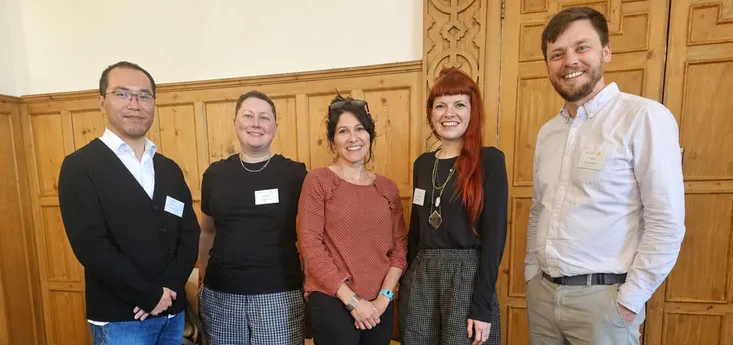
Five Swansea University researchers have been selected for the 2026 Welsh Crucible — taking a sixth of the 30 places available across the whole of Wales.
The Welsh Crucible picks 30 researchers from across the country each year for a series of intensive residential skills labs, designed to sharpen research impact, spark collaboration across disciplines and build international careers.
The programme is open to early- and mid-career researchers from any discipline — science, engineering, medicine, the arts and social sciences — with at least three years’ research experience under their belts.
It is run by a consortium of Welsh universities, and modelled on the “Crucible” development programme created by innovation charity Nesta.
The Swansea five span a striking range — from unpaid carers and literature to community research and artificial intelligence.
Dr Maria Cheshire-Allen, a senior research fellow in social care, researches unpaid carers, older people and social justice, and holds two concurrent Health and Care Research Wales awards.
Dr Laura Seymour, a Wellcome Trust fellow and senior lecturer in English literature, studies how neurodivergent people engage with literature — and how books can support wellbeing and self-understanding.
Dr Charlotte Jones, a sociology lecturer, works at the crossroads of gender, sexuality, disability and medicine, including the pressures faced by academics whose research draws public backlash.
Dr Tom Avery works across south-west Wales for the university’s Local Challenges Research Office, building research collaborations between communities, policymakers and academics — with a focus on giving local people a voice in how their areas are run.
And Dr Yang Liu, a senior lecturer in computer science, researches cybersecurity and trustworthy AI — how to build artificial intelligence systems that protect privacy and can be relied on in the real world, from autonomous vehicles to connected devices.
Professor Siwan Davies, the university’s Pro-Vice-Chancellor for research, innovation and enterprise, said the selection reflected what the five could go on to achieve.
“We are immensely proud to see that five of our researchers have been selected for the Welsh Crucible programme. This reflects their outstanding talent, ambition and collaborative spirit, as well as their potential to be future leaders who will deliver meaningful impact for Wales and beyond,” she said.
The Welsh Crucible is funded by the university consortium together with Medr, Wales’ commission for tertiary education and research.
The recognition comes with the university’s research stock riding high — Swansea reached its best-ever position in the QS World University Rankings last year, at 292nd globally.
In the most recent national research assessment, 86% of the university’s research was rated world-leading or internationally excellent.
The selection also caps a run of research news for the university, whose scientists recently helped achieve a world-first hydrogen aero engine test with Rolls-Royce and easyJet.
Swansea was also chosen this year to host a Google DeepMind programme opening up AI research careers to students from disadvantaged backgrounds.
The five will join the rest of the 2026 cohort at the programme’s residential labs over the months ahead.