


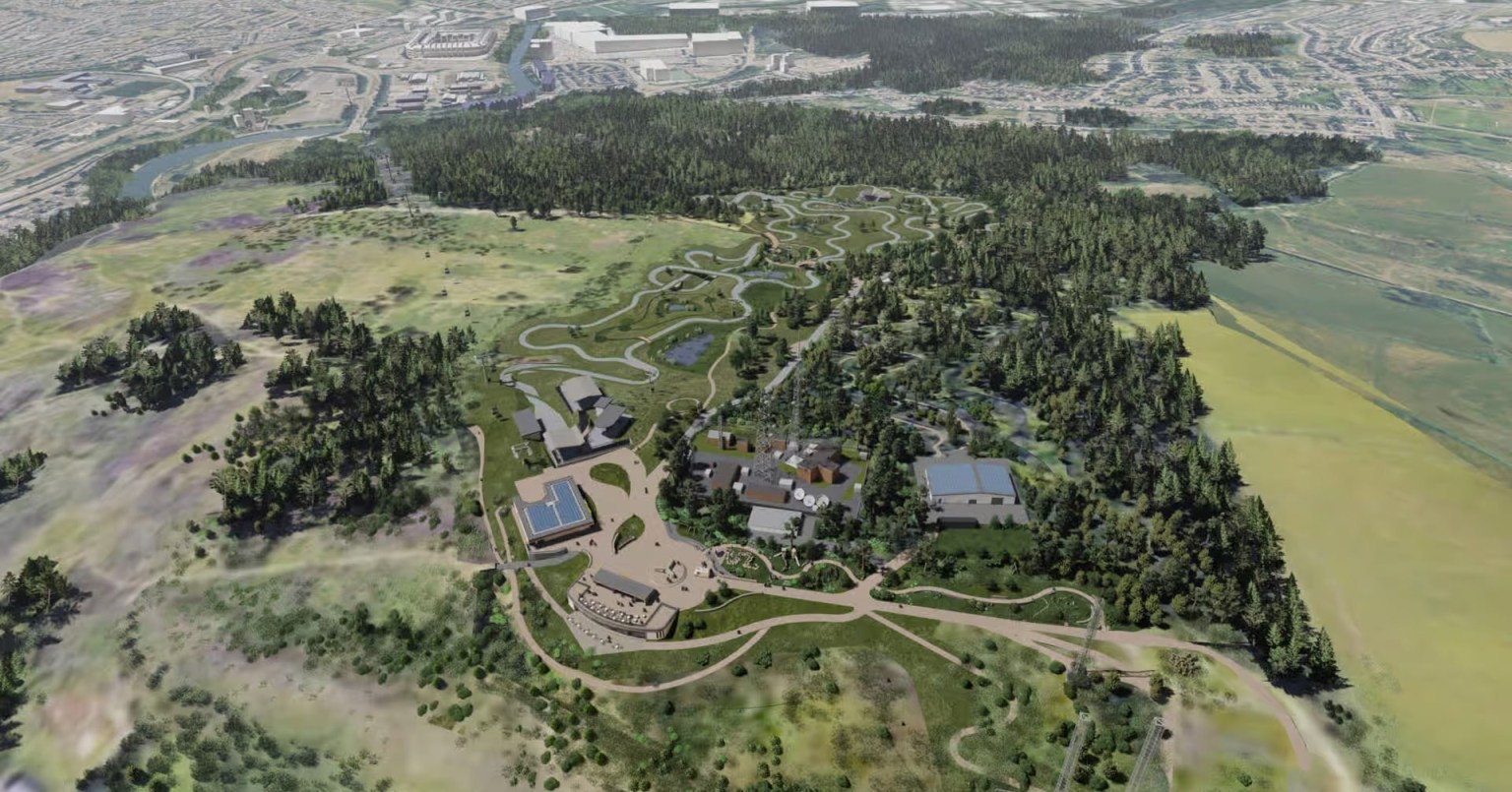
Swansea Council has refused to say how much public money could be lost if the Skyline project on Kilvey Hill does not go ahead — telling a questioner there are “too many variables” to give a worst-case figure.
The answer comes in written responses published for tonight’s full council meeting (Thursday 2 July), replying to a series of public questions on the scheme put by Ben Houghton at Council in March.
The responses confirm the council’s Skyline budget has risen from about £8.1m to £10.205m — and that the extra £2.1m “was not part of the original approved plan”.
The uplift was formally approved by Cabinet on 17 July 2025 through a financial procedure report, and covers higher-than-anticipated land assembly costs involving third parties, additional highways and access works, utilities to the site boundary, and the council’s own project management and staffing costs.
Budget papers profile the spending at £2.866m this financial year and £7.258m in 2026/27.
Just under £8m of the total is unsupported borrowing — debt the council services itself — with repayments prudently assumed at just under £700,000 a year, though the authority says the final terms will be set when the money is actually borrowed.
Asked for the council’s worst-case estimate of non-recoverable costs if the project does not proceed, the response was blunt: “As this project is in its infancy, there are too many variables for an answer to be provided.”
The council said money advanced to Skyline as loans is “expected to be fully repaid”, with further reimbursements “partly based on financial performance in practice”.
The £49m attraction — a gondola carrying visitors from Landore to the summit of Kilvey Hill, with three luge tracks, a sky swing and new trails at the top — is due to open in mid-2028.
But the answers confirm the occupational lease between the council and Skyline has not yet been signed, with planning conditions — including land stability assessments — still to be discharged. The council insists the outcomes “have not been predetermined”.
Mr Houghton asked whether works already carried out on the hill — he listed fencing, clearance, hardstanding, drainage installation, temporary access tracks and construction compounds — count as formally commencing the development under its planning permission.
Swansea Council said it was “not aware of any works that have taken place to date to formally commence the development”, describing the activity so far as agreed reptile mitigation and temporary works for vegetation clearance and a footpath diversion.
That characterisation sits alongside Skyline’s own recent updates, which showed earthworks under way near the summit and walkers diverted from footpaths while the work is carried out.
Mr Houghton, who told councillors the authority had already spent around £3m, asked whether committing further funds before conditions are met was “extremely unwise”. The council said it was not — pointing to a “phased and controlled approach”, legally binding agreements it says protect its interests, and the significant private capital Skyline is committing.
The council also restated its case for the scheme: a major leisure and tourism attraction supporting jobs and visitor spend, and a catalyst for the wider regeneration of the Hafod-Morfa Copperworks and Kilvey Hill.
The written answers land in a week when opposition to the scheme reached the Senedd — where the Welsh Government’s top law officer told Swansea MS Gwyn Williams that public opposition, however strongly felt, is not in itself a material planning consideration.
Elsewhere in the responses, the council conceded that footfall-generating regeneration projects are “necessary but not sufficient” to keep large national retailers in the city centre — attributing the departure of Marks & Spencer to corporate decisions beyond its control.
The written responses will be formally received when full council meets at 5pm tonight.

Discover more from Swansea Bay News
Subscribe to get the latest posts sent to your email.

Utterly shameful destruction of a hard-won green environment by the Labour party. Elect a Plaid Cymru council next May.