


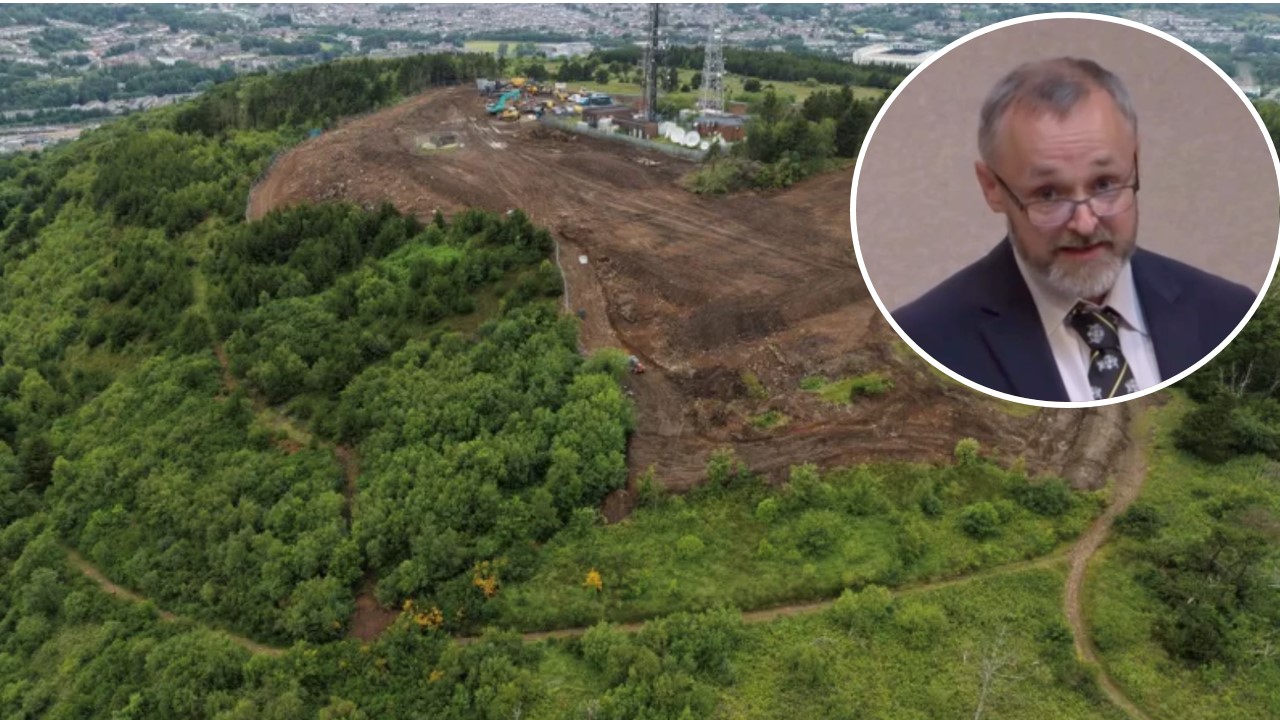
A Swansea politician has taken the campaign against the Skyline development on Kilvey Hill to the Senedd’s top legal officer — only to be told that public opposition, however strongly felt, carries no weight in planning law.
Gwyn Williams, the Plaid Cymru member for Swansea’s Gŵyr Abertawe seat, pressed the Counsel General, Elfyn Llwyd, during questions in the Senedd on Tuesday.
Williams asked what legal advice the Welsh Government could offer to challenge planning decisions approved by councils despite strong local objection.
Llwyd replied that Welsh ministers do have powers to revoke, modify or discontinue a planning permission granted by a local authority, set out in the Town and Country Planning Act 1990.
But he said those powers would only be used where the original decision was “so grossly wrong that damage would be done to the wider public interest” — and added that they are very rarely used.
In a supplementary, Williams raised Kilvey Hill directly, saying he had received more emails about it than any other issue in his six weeks as a member.
He described the hill as one of the most beautiful places in Swansea, with an ecology shaped by the soil left poisoned by the city’s copper-smelting past, and noted that his own son had trained there before joining the Royal Artillery.
Williams asked what advice Llwyd would give to the Save Kilvey Hill campaign, which opposes the development.
The Counsel General’s answer was a careful rebuff. Giving the campaign advice “would get me the sack,” he said, to laughter in the chamber.
He went on to set out the legal reality for objectors, telling the Senedd that “public opposition is not in itself a material planning consideration.”
It was for objectors to set out proper planning reasons for why a development should be refused, he said. Anyone could challenge the way an application had been handled through judicial review if they believed it was legally flawed — but it was not possible to challenge the reasoning behind a decision.
Llwyd added that he could not comment on the merits of the case, as it might come before Welsh ministers at a later date and he did not want to prejudice any role he might then have.
The legal position lands at a late stage in the story. Swansea Council’s planning committee approved the scheme in March 2025, and construction began earlier this year, with earthworks on the hill and groundworks at Landore Park and Ride.
The £49m attraction, by the New Zealand-based operator Skyline Enterprises, is to feature a cable car, a downhill luge, a zipline, a sky swing, a restaurant and enhanced walking and mountain bike trails. It has also drawn £4m of Welsh Government investment.
The company has said the project is expected to create 100 local jobs within a year of opening and around 450 during construction, to be worth £84m to Swansea’s economy over 15 years, and to draw some 450,000 visitors in its first full year.
Skyline has said all existing footpaths and access points to the hill will remain open, and that the scheme includes tree planting, habitat protection and other ecological measures designed with Natural Resources Wales requirements in mind.
Opposition has been vocal but limited in number. Around 50 objectors gathered outside the Guildhall when the planning committee met, and the development has since seen protest activity that prompted a police warning in April, while walkers have more recently faced footpath diversions as work moved onto the summit.
Swansea Council has welcomed the development, describing it as an exciting project for the east side of the city.

Discover more from Swansea Bay News
Subscribe to get the latest posts sent to your email.





If Swansea Council was taking climate change seriously this development would not havd got planning permission instead a sustainable tourism plan would have been implemented with just as many jobs generated from a managed network of trails, sculptute park and maybe a small zipline for visitors. All thos could have achieved with local Welsh firms anx community groups. We have the wrong Labour councillors in place their decision making is flawed and dishonest with the public