


One of Japan’s biggest trading companies has bought into the floating wind farm planned in the Celtic Sea off the south west Wales coast.
Sumitomo Corporation has joined the Gwynt Glas project as an equal partner alongside EDF power solutions UK and Ireland and Irish state energy firm ESB, with each now holding a third of the venture.
Pembroke Dock-based developer DP Energy, which helped launch the project, continues to provide development support, with the partners saying its expertise covers early stage delivery and local engagement.
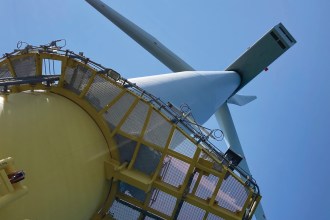
Gwynt Glas is a proposed floating offshore wind farm of up to 1.5GW in the Celtic Sea, half as large again as the 1GW scheme first announced by EDF and DP Energy in January 2022.
The project submitted its scoping report to the Planning Inspectorate this summer, the first formal step on the road to a full planning application.
The partners say the deal positions the project to “advance confidently through its next phases” and reinforces its role in delivering clean energy for Wales and the UK.
Matthieu Hue, chief executive of EDF power solutions UK and Ireland, said the company was delighted to welcome Sumitomo. Its global experience in offshore wind development and investment, he said, complemented EDF’s and ESB’s, “creating a powerful partnership dedicated to delivering this vital project for Wales and the UK”.
Jim Dollard, executive director for generation trading at ESB, called the deal “another significant step” for a project he said was important to ESB because offshore wind would be “a cornerstone” of its net zero strategy.
Jun Minase, general manager of Sumitomo Corporation’s overseas energy solutions unit, said the UK remained “an important strategic market” for the company, and that it would use its experience in the UK market and the offshore wind sector to support the project’s development.
Gwynt Glas secured its site under the Crown Estate’s Offshore Wind Leasing Round 5, one of three floating wind farms in the Celtic Sea which together are expected to generate enough electricity to power more than four million homes.
Port Talbot has been identified among the front-running candidates for turbine assembly and deployment for the Celtic Sea projects, with its deep-water access and industrial infrastructure seen as a natural fit for the heavy engineering involved.
Round 5 rules also require developers to ensure at least 3.5% of their workforce are apprentices, and that 10% of employees aged 19 to 24 are recruited from those not in education, employment or training.
When the project was first unveiled, DP Energy said its Pembroke Dock team was made up entirely of people born and raised in Wales, and spoke of building a sector that could sustain skilled, well-paid jobs in coastal communities.
The wind farm would sit around 70km offshore, in an area of the Celtic Sea likely to span both Welsh and English waters.
Development work continues ahead of a full planning application, with construction still some years away.
Related stories from Swansea Bay News
Port Talbot tipped for key role as third Celtic Sea wind farm confirmed
The trio of Round 5 floating wind farms and what they could mean for the port.
1 GW ‘Gwynt Glas’ floating offshore wind project announced in the Celtic Sea
How the project began as an EDF and DP Energy joint venture in 2022.
Crown Estate funds new offshore wind supply chain programme in South Wales
Backing for local firms entering the floating wind sector.

Discover more from Swansea Bay News
Subscribe to get the latest posts sent to your email.