The power lines planned down the Towy Valley could face a much tougher test, after ministers proposed making buried cables the default for new lines of this kind in Wales.
If the plans go ahead, big steel lattice pylons would be ruled out for new lines of up to 132kV, the voltage of both Green GEN Cymru routes, and anything overhead would be allowed only by exception. Even then, it would have to hang from wooden poles or something shown to be less intrusive.
That leaves a question hanging over the 22-metre steel poles the company now wants to use instead. The Welsh Government is asking for evidence on “wooden poles, monopoles (wood or steel) or other less visually intrusive types of overhead line infrastructure”.
It has not said whether the new rules will apply to schemes already being planned. The consultation closes on 15 January 2027.
Towy Usk and Towy Teifi: the 22-metre poles campaigners say are not low
Last month Green GEN Cymru said it was swapping the lattice pylons on both routes for single steel poles around 22 metres tall, with a prototype due in early 2027.
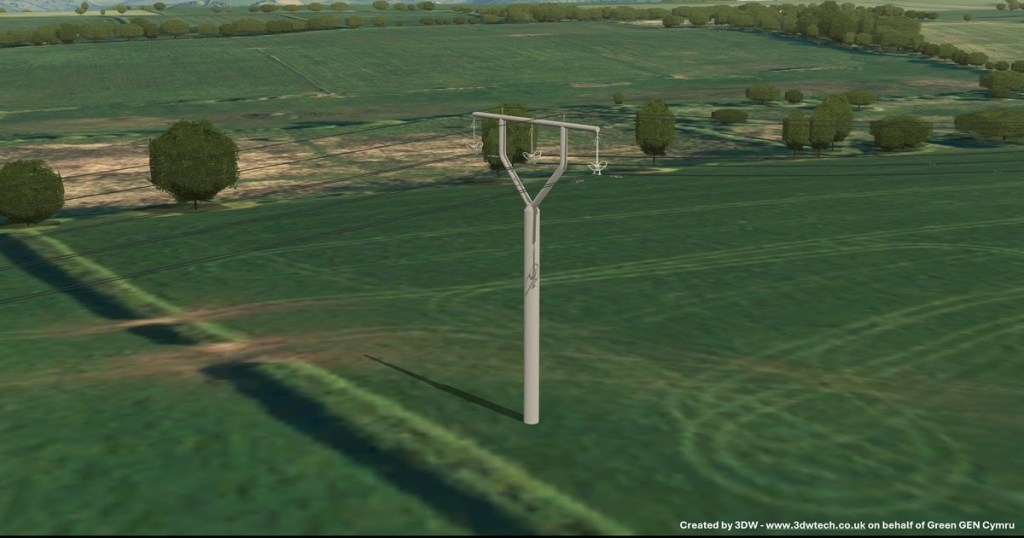
The company had put the lattice pylons it planned at around 27 metres tall. It says one line of the new poles can carry what might otherwise take up to four wood pole lines side by side.
Campaigners in Llandovery were not convinced. A spokesperson for the Llandovery Pylon Steering Group said a 22-metre pole “is not a low wooden pole, and it is not less intrusive infrastructure”.
Green GEN Cymru said last year that burying the lines in full was not economically viable. Executive director Andrew Hardcastle said in September the monopole gave the company “greater flexibility”, alongside its wooden poles, lattice structures and undergrounding.
Adam Price’s pylon pledge, in a constituency both lines cross
Adam Price, the Cabinet Minister for Enterprise, Connectivity and Energy, whose Sir Gaerfyrddin constituency both lines cross, said: “We’re delivering on our manifesto commitment to end the use of steel lattice pylons and ensuring the default position for new electricity lines in Wales are underground.”
In May he went further, telling S4C there would be “no new pylons and distribution lines in Wales that are part of our control”.
The Welsh Government says the plan delivers a Plaid Cymru manifesto promise to “immediately prohibit the use of large steel lattice pylons for new 11-132 kV lines in Wales”.
Price acknowledged the other side of it: “We know the necessary changes in the way energy is generated and used in Wales will require new grid infrastructure, however we also know that new infrastructure can impact on the communities and the environment that hosts it.”
Burying power lines costs more, and electricity bills pick up the tab
Burying cables is generally more expensive to install and maintain, and brings its own disruption while the work is done, the Welsh Government says. The cost of the network is “ultimately met through utility bills”, it says.
On the other side of the ledger, it says buried lines are less exposed to some types of severe weather and can reduce harm to birds and other wildlife.
Underground first: the three tests a new overhead power line could have to pass
Planning policy in Wales already prefers new lines underground “where possible”, weighed against cost. If the new approach is adopted, anyone wanting to go overhead would have to show, with evidence, why a line should not be buried.
The Welsh Government proposes three tests for when an overhead line might be justified: where burying it does more harm to the environment, where it is not physically possible because of geology, geography or engineering risk, and where it makes the project financially unviable.
Both Green GEN Cymru lines end at a new substation planned at Llandyfaelog. The Gwynt Glas floating wind farm already plans to bury its cables all the way there from the Carmarthen Bay coast.
Underground-first pylons plan: where to send a response
Responses can be made online at gov.wales before the deadline, with a further statement on next steps due early in the new year.
People can also email YmatebionYnni-EnergyResponses@gov.wales, or write to Energy Division, Welsh Government, Cathays Park, Cardiff CF10 3NQ.

Discover more from Swansea Bay News
Subscribe to get the latest posts sent to your email.