The 1.5GW floating wind farm planned for the Celtic Sea expects to plug into the grid at Llandyfaelog, and it plans to get there underground. That sets it apart from the two contested overhead lines heading for the same village from the north, where the fight has been over pylons.
Gwynt Glas says its drop-in sessions next month will focus on the onshore works, and project director Mark Hazelton is inviting people to come along and “understand where the cables might go”.
So far the answer is a boundary rather than a line. The scoping area the developer has lodged with the Planning Inspectorate hugs the whole Carmarthen Bay coast, from Folly Farm and Tenby in the west to Burry Port and Llandyfaelog in the east.
The Inspectorate’s project page says the grid connection is expected at the new National Grid substation proposed at Llandyfaelog, with underground export cables from the landfall and a second, onshore substation built near it. Several landfall and cable route options are still under consideration.
The map marks three points of interest inside or beside that boundary: Folly Farm, the National Botanic Garden of Wales and Ffos Las Racecourse.
Pylons from the north, cables from the sea: Llandyfaelog’s substation gets busier
The National Grid substation went out to its own public consultation in June 2025. The plan is a 400kV site around 6km south of Carmarthen, reached from a new access road off the A484 between Llandyfaelog and Idole.
National Grid said at the time it was proposing the site in response to connection requests from Green GEN Cymru, whose Towy Usk and Towy Teifi lines both finish there, and from the local distribution network.
Those two lines have met fierce opposition across Carmarthenshire. Last month Green GEN Cymru said it was swapping its steel lattice pylons for 22-metre single poles, a design campaigners in Llandovery called neither low nor less intrusive.
Now the seaward side of the same substation is coming into view, and on the developer’s plans there are no poles or pylons in it: subsea cable to the shore, then buried cable to Llandyfaelog.
Three drop-ins, 17 to 19 November, all at the Llandyfaelog end
The first session is at Llandyfaelog Community Hall on Tuesday 17 November, from 11am to 4pm, with Pembrey Memorial Community Centre taking the same hours on Wednesday 18 November. The Princess Gwenllian Centre in Kidwelly hosts the last, an evening session from 4pm to 7pm on Thursday 19 November.
Nothing has yet been announced west of Laugharne, even though the boundary takes in Tenby and Folly Farm. For anyone who cannot get to a hall, the information boards, maps and feedback forms go online at gwyntglas.com from 16 November to 11 December.
Mr Hazelton said the project was “at an important stage” of its design. “We are committed to delivering our project with communities and local knowledge is vital to helping us get this right. We want to design a project that not only delivers clean, secure energy but also respects and supports the local environment and communities.”
He added: “Whether you want to ask questions about what is proposed, understand where the cables might go or share your thoughts on local environmental considerations, please come along. The team is looking forward to welcoming everyone.”
42km out, 369 square kilometres, and a decision taken in Westminster
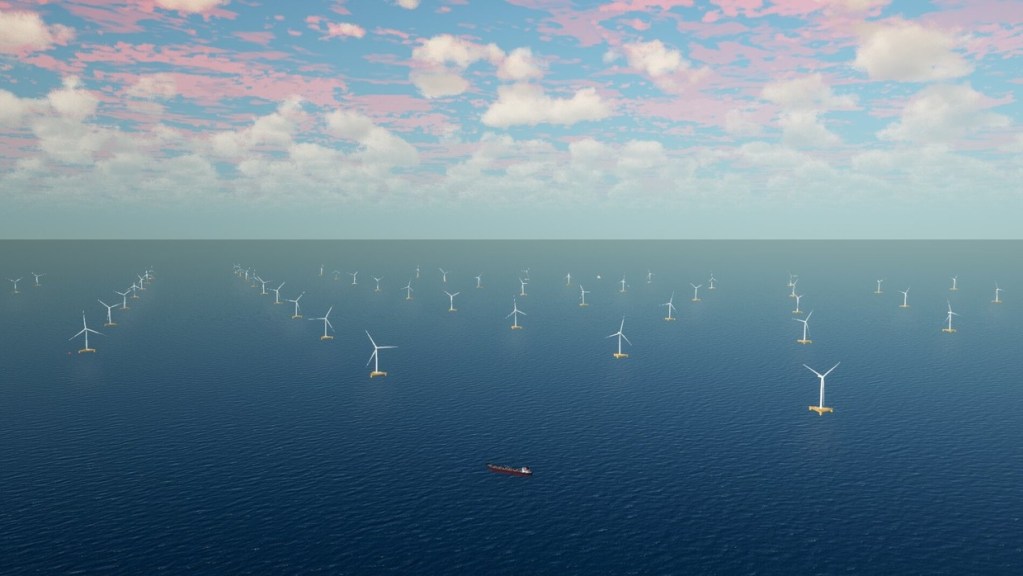
The turbines themselves would sit around 42km off the south-west coast of Pembrokeshire, across an array of roughly 369 square kilometres, according to the Planning Inspectorate. The water there is too deep for turbines fixed to the seabed, so they would stand on floating platforms anchored by cables.
At up to 1.5GW the scheme counts as a Nationally Significant Infrastructure Project. It will be examined by the Planning Inspectorate and decided by the UK Secretary of State, with a separate marine licence from Natural Resources Wales for the Welsh waters it crosses.
The developer filed its environmental scoping report in June, the first formal step towards that application. The Inspectorate’s note of a meeting with the company in May records that it intends to use standard cable laying and trenchless methods where available, with a survey of the export cable corridor planned for spring 2027.
The site has moved closer to shore since EDF and DP Energy first announced the project in January 2022, when the area of search covered 1,500 square kilometres around 70km out and the target was 1GW.
Gwynt Glas is now owned in equal thirds by EDF power solutions UK and Ireland, Irish state energy firm ESB and Japanese trading giant Sumitomo, which bought in during August. Pembroke Dock-based DP Energy continues to provide development support.
It is one of three floating wind farms awarded sites in the Crown Estate’s Round 5 leasing, which together are expected to power more than four million homes. Port Talbot is among the ports tipped for turbine assembly.
Related stories from Swansea Bay News
POLES APART: Towy Valley pylon firm swaps steel towers for 22-metre poles, just five metres shorter
The two Green GEN Cymru lines that end at Llandyfaelog.
Residents of small Carmarthenshire village to have say on new substation plans
National Grid’s 2025 consultation on the Llandyfaelog site.
CELTIC SEA: Japanese giant Sumitomo buys into 1.5GW wind farm planned off south west Wales
How the three-way partnership came together.
CELTIC SEA: 21 underwater microphones are listening for whales and dolphins before the floating wind farms arrive
The seabed survey under way where the turbines would go.

Discover more from Swansea Bay News
Subscribe to get the latest posts sent to your email.