


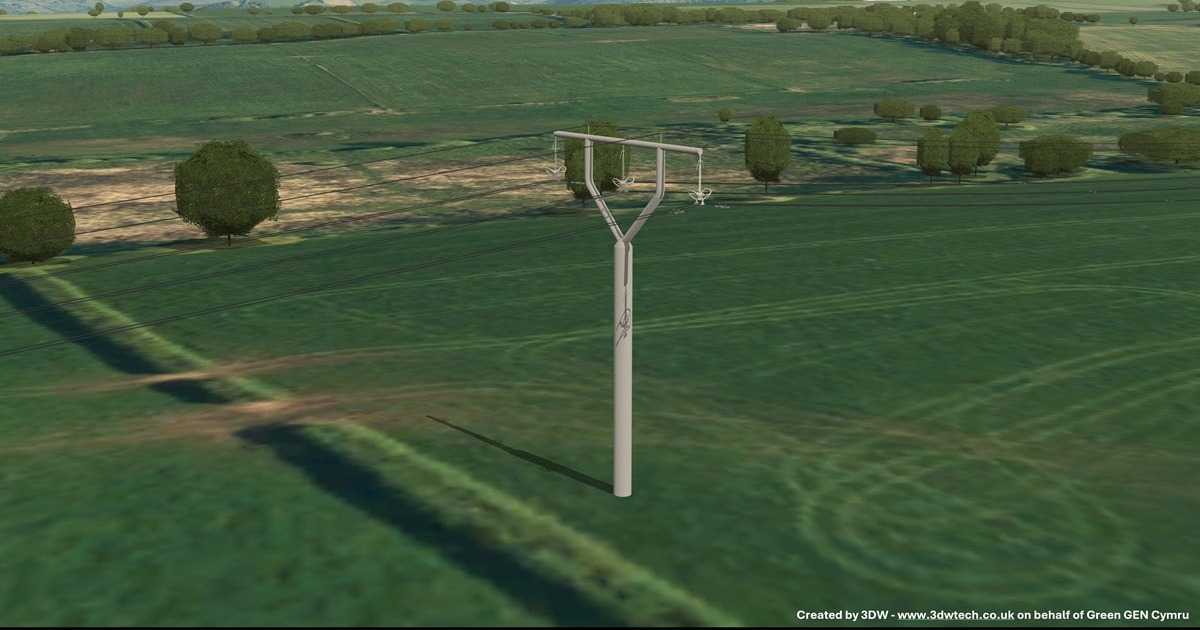
The steel lattice pylons planned to march down the Towy Valley could be swapped for single steel poles standing around 22 metres tall.
Green GEN Cymru, the company behind both routes, says it is developing the new “monopole” for its Towy Usk and Towy Teifi lines. A prototype is due in early 2027.
The two lines have met fierce opposition across Carmarthenshire, where campaigners packed a hall in Pumsaint last year to warn of the “industrialisation” of the countryside.
Both finish at the same spot: a new National Grid substation planned at Llandyfaelog, up the road from Kidwelly.
Towy Usk would run there from a proposed wind farm in the Radnor Forest in Powys, coming down the valley past Llandovery. The company’s latest route update also includes a longer buried section near Llanarthney.
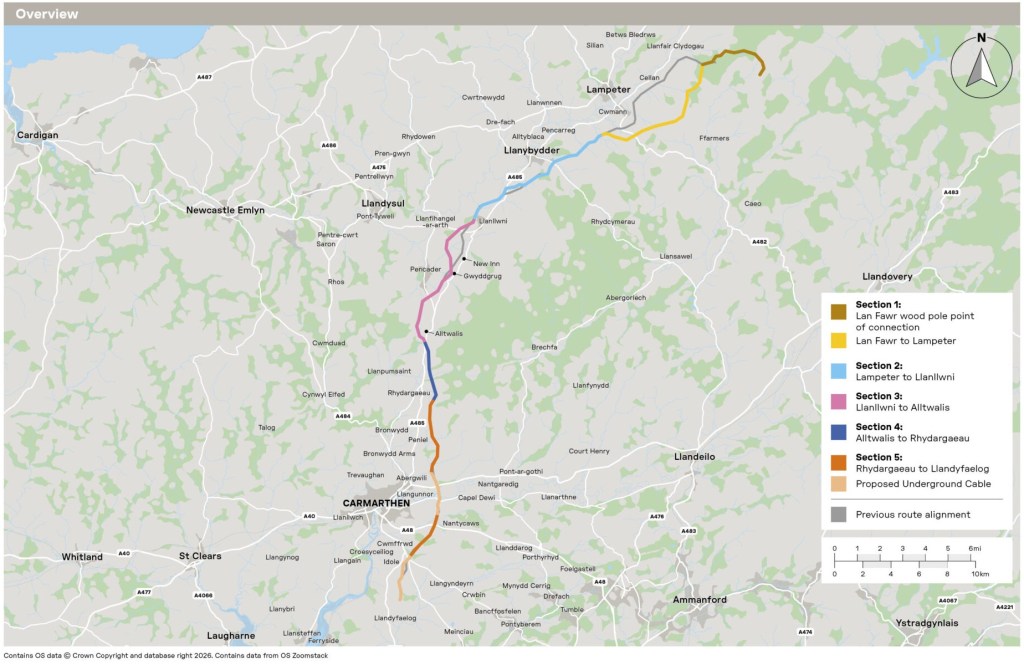
Towy Teifi starts at another proposed wind farm, Lan Fawr, east of Llanddewi Brefi in Ceredigion. It heads south past Lampeter and Llanybydder, then on by Llanllwni, Alltwalis and Rhydargaeau.
From there it skirts the east of Carmarthen. The company’s route map shows the cable going underground at Abergwili, where it crosses the Towy and the A40, and again from Idole to the substation.
Green GEN Cymru says its latest changes lengthen both buried stretches, cut the total number of pylons, and move the line further from Llanfair Clydogau, Cellan, Cwmann, Lampeter and New Inn.
How tall is a 22-metre monopole? About five metres shorter than the pylons first planned
The company’s pitch is that the monopole stands at “around half the height of a typical 275kV pylon”, with a small footprint on the ground.

But 275kV giants were never on the cards here. Both lines are 132kV, and Green GEN Cymru said in March that the lattice pylons it intended to use stand approximately 27 metres tall and five metres wide.
On the company’s own figures, that makes the new pole around five metres shorter, though far slimmer.
Countryside charity CPRW put the average pylon on the Towy Teifi line at 29.5 metres when the route went out to consultation last year, with around 212 of them along its 52km.
Green GEN Cymru says one line of monopoles can carry what might otherwise need up to four separate wood pole lines running side by side.
The poles would carry a high-capacity cable the company has named ACCC Cardiff, which it says moves significantly more electricity while allowing slimmer structures.
What Plaid Cymru promised on pylons before the election
The timing is no accident. Plaid Cymru took power in May with a pledge on exactly this kind of power line.
Its manifesto promised to “immediately prohibit the use of large steel lattice pylons for new 11-132 kV lines in Wales”, with “a clear presumption in favour of undergrounding”.
Overhead lines would be allowed only “where installation is via low wooden poles or equivalent, less intrusive infrastructure”.
Whether a 22-metre steel pole counts as equivalent to a low wooden one is now a question for ministers.
The energy brief sits with Adam Price, Cabinet Minister for Enterprise, Connectivity and Energy, whose Sir Gaerfyrddin constituency both lines cross. He is currently consulting on a publicly owned Welsh energy company.
The Welsh Government told the BBC it would be “inappropriate to comment on specific planning proposals” because of ministers’ role in deciding them. It said it was developing a National Energy Strategy.
‘Not a low wooden pole’: Llandovery campaigners hit back
Campaigners are unimpressed. The Llandovery Pylon Steering Group is reported to have said the new poles are neither “low” nor “less intrusive”, and stand more than twice the height of a nine-metre telegraph pole.
A spokesperson for the group said a 22-metre pole “is not a low wooden pole, and it is not less intrusive infrastructure”.
The group claims monopoles would need to sit closer together than lattice pylons, every 160 to 180 metres rather than around 250. It estimates that could mean 150 to 220 extra structures on the Towy Usk line alone.
Green GEN Cymru is reported to say the poles are being designed for similar spacing to its lattice pylons, at around four per kilometre.
Dr Jonathan Dean of CPRW told the BBC the new design would not win over opponents. He said separate transmission plans being weighed by the National Energy System Operator could make Green GEN Cymru’s lines redundant.
Dyfan Walters, who farms on the edge of Llandovery near one of the proposed routes, told the broadcaster that burying the cables was the only option he would accept. But he said forcing the company to change its plans was “a win for the community”.
Last September the company said it would always try to reduce the visual impact of its projects, but that burying the lines fully was not economically viable.
Andrew Hardcastle, executive director at Green GEN Cymru, said Wales would need more network capacity as demand for electricity grows.
“Developing the monopole, alongside our existing use of wooden poles, lattice structures and undergrounding, gives us greater flexibility and helps ensure we can deliver the resilient electricity network Wales needs,” he said.
The company has acknowledged that politics played its part. It told the BBC that community feedback and the political climate were among the reasons it went looking for a different design.
Welsh steel and a £1bn spend: Green GEN Cymru’s jobs pitch
Both lines are being built to plug wind farms planned by Bute Energy, Green GEN Cymru’s sister company, into the grid.
The company says it plans to invest nearly £1bn in new electricity infrastructure, and wants the steel poles fabricated in Wales.
Stephen Rowlands, its head of construction and supply chain, said: “Wales has a proud history of manufacturing and engineering, and we believe there is a real opportunity for Welsh industry to play a leading role in developing and delivering the next generation of electricity infrastructure.”
Green GEN Cymru says electricity demand in Wales is projected to triple by 2050, and the grid cannot yet carry everything the region could produce.
The company says it will consult again on changes to both routes later this year, with public events where people can question the project team. One is reported to be in Llandovery on 15 October.

Discover more from Swansea Bay News
Subscribe to get the latest posts sent to your email.