


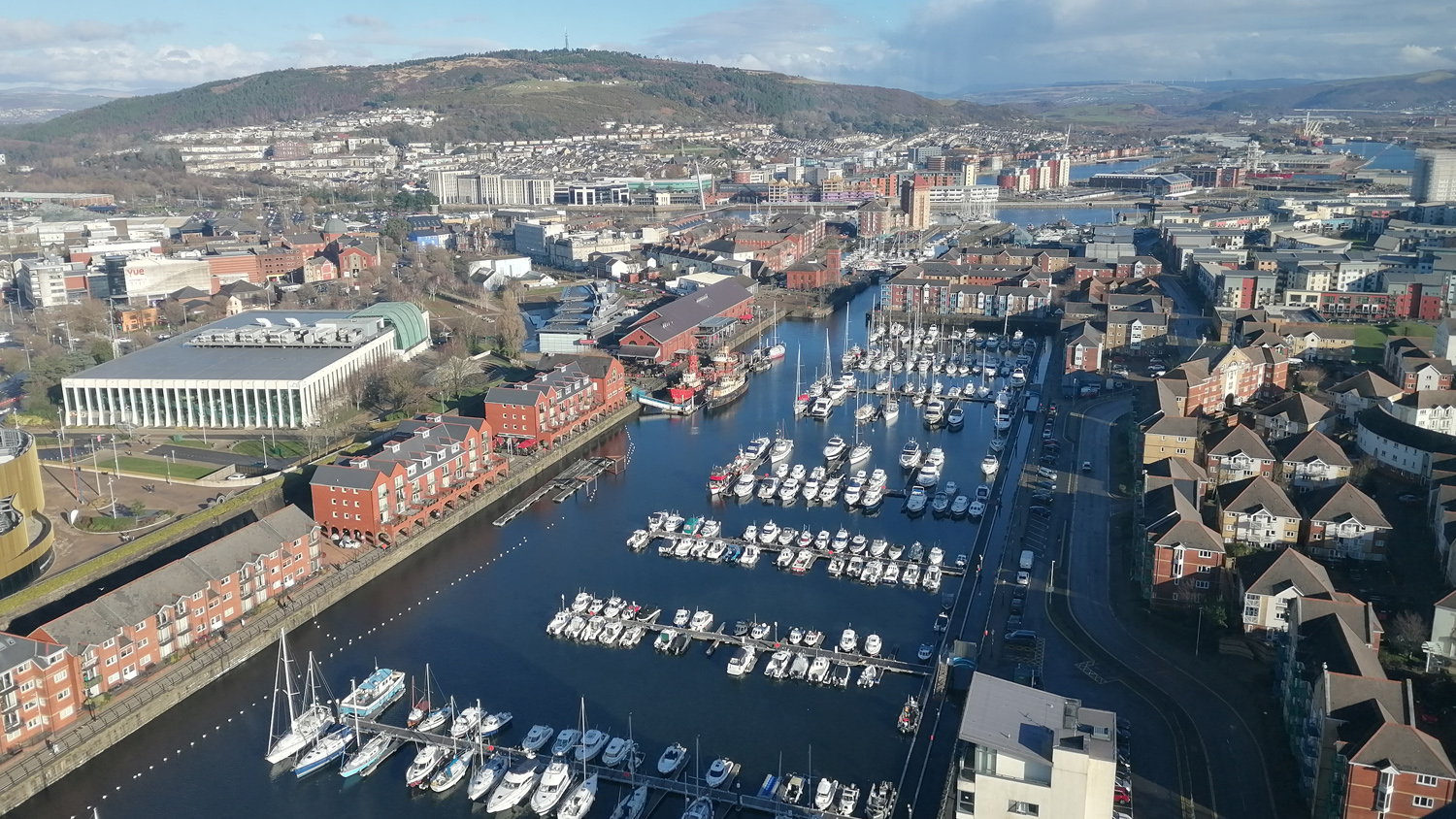
The man who chairs the company that owns Swansea and Port Talbot docks has been handed the job of shaping Wales’ new economic development agency.
Jonathan Lewis, chair of ports giant Associated British Ports, was named this week to lead the expert panel that will design the agency’s remit and operating model.

The agency is the Welsh Government’s answer to what it calls the most ambitious economic goal in Wales in two decades: halving the country’s productivity gap with the UK within 10 years.
It will focus on attracting inward investment, helping Welsh businesses scale up, and putting innovation at the centre of economic development.
Mr Lewis’s day job gives him a direct stake in the region’s economy — ABP owns five Welsh ports including Swansea and Port Talbot, both central to the Welsh Government’s offshore wind ambitions.
His career spans energy, engineering and technology, with previous chief executive roles at outsourcing firm Capita and engineering group AmecFosterWheeler, and years working alongside national development agencies in the United States and beyond.
Cabinet Minister for Enterprise, Connectivity and Energy Adam Price said meeting the productivity challenge needed “a fundamental change in how we approach economic development in Wales”.
“The new agency will be agile, dynamic and built for the Wales of today,” he said, adding that innovation would be at its core.
Mr Lewis said improving Wales’ productivity was “core to realising our future prosperity as a nation”.
What the agency does for this corner of Wales was an immediate theme in the Senedd, where Plaid Cymru’s Elyn Stephens said Port Talbot “has all the ingredients to succeed” — citing the freeport, public investment and the steel transition — and pressed the First Minister on how the agency would ensure “the wealth generated in places like Port Talbot stays in Wales”.
Rhun ap Iorwerth said the agency’s job would be to bring “coherence” to economic development — including in Port Talbot, “which has faced real challenges but has so much potential too”.
The announcement also lands amid pressure for a bigger government presence in Swansea, where Plaid’s Gwyn Williams told the Senedd last week the city’s economy is “slipping further and further behind that of Cardiff” — urging the Senedd Commission to consider opening an office in the city, and voicing hopes that the Welsh Government’s Penllergaer office moves to the city centre.
The First Minister has himself said the old Welsh Development Agency — wound into the Welsh Government in 2006 — was “one of the best” of its kind, telling the Senedd “it was a problem to get rid of it” — a view with local resonance, given a revived WDA has been floated as key to Swansea’s city-centre offices deal and the decades-long frustration over the stalled Felindre site.
But the plans drew immediate fire from the Welsh Conservatives, whose shadow environment minister Andrew RT Davies said he “generally can’t get a sense that much work has been done on this particular project”.
Mr Davies pressed the minister to say when the agency would exist — 12 months, two years, or the end of the Senedd term. Mr Price replied: “I can’t give you a specific date, to be frank” — though he committed to a statutory body, legislation “fairly soon”, and an operational agency during this Senedd term.
Mr Davies said the Conservatives supported the principle of moving economic development out of government, but told the chamber “there’s too much blank space” — adding in a statement that the lack of a date was “a symptom of a manifesto that included lots of pledges, but no plan”.
He also questioned how the agency would work alongside Wales’ existing growth and city deals — which include the Swansea Bay City Deal — without duplicating spending.
The full membership of the advisory panel will be confirmed later this summer — against a backdrop of a widening jobs and wages gap between Wales and the rest of the UK, though Wales landed 75 foreign investment projects and 1,600 jobs last year even as UK-wide investment hit a decade low.

Discover more from Swansea Bay News
Subscribe to get the latest posts sent to your email.