

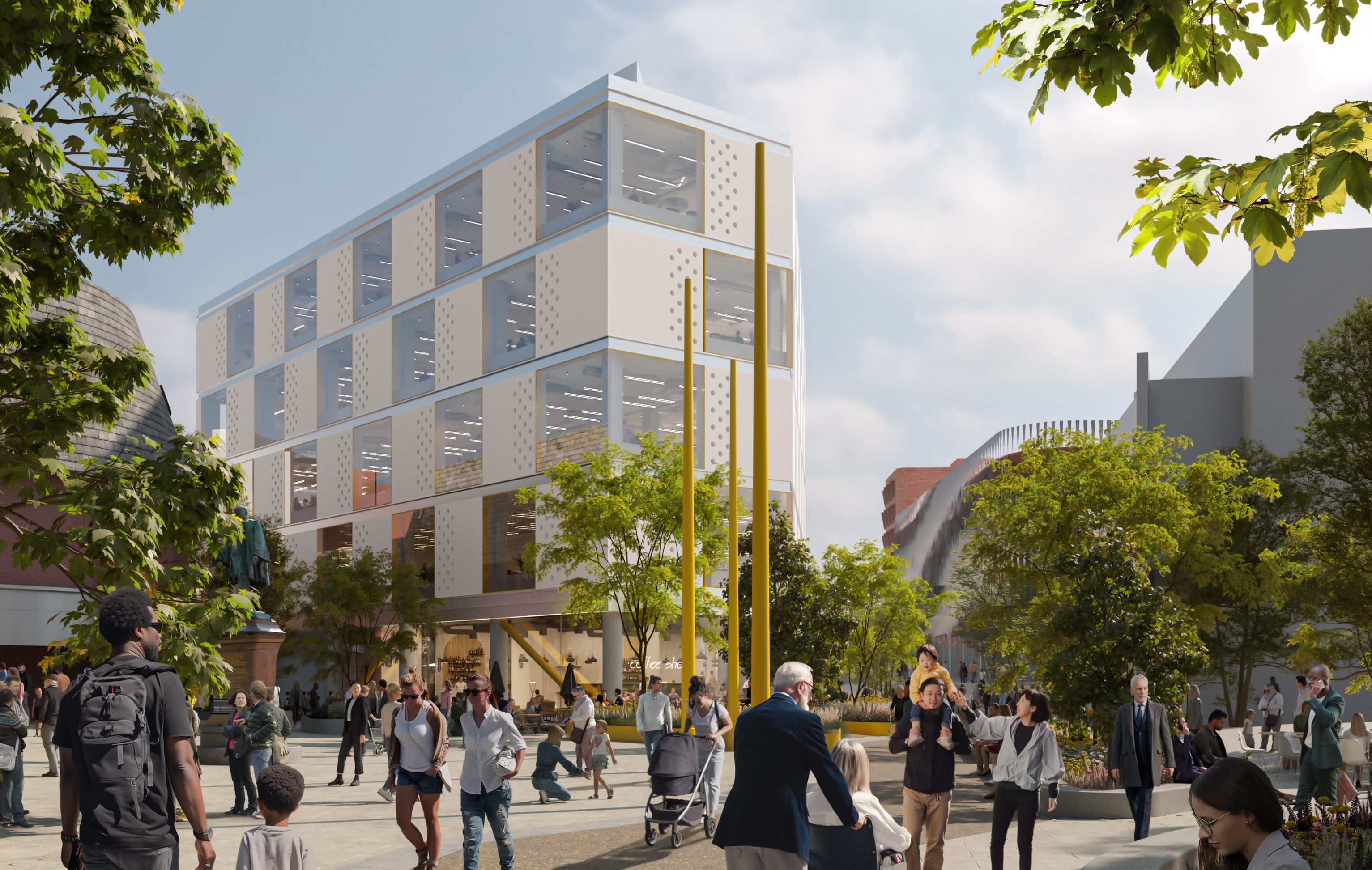
Construction of the office building — known as Block B, the first phase of the new public sector hub being built as the council’s new home at the former St David’s site — is due to step up within weeks, with work starting on site in July and completion targeted for early 2028.
But a key question still hangs over it: who, beyond the council itself, will fill it.
The deal that was signed — then left in limbo
The council and the previous Labour-led Welsh Government exchanged letters of intent before the Senedd election to bring Welsh Government staff into the new hub.
The proposal centred on relocating staff from the government’s offices near junction 47 of the M4 at Penllergaer — where average daily attendance was running at just 10% in early 2025 — into the city centre, with the council potentially taking on the Penllergaer building in return.
Then the election came, Plaid Cymru took power, and the new administration said it would review its office estate before committing to anything.
That left the council waiting to find out whether the deal would survive the change of government.
‘It would be ill-advised’
Pressed at a scrutiny panel this week on whether the council could hold the new government to the letter of intent, leader Rob Stewart was blunt about the idea of legal action.
He said it would be “ill-advised” for the council’s first dealing with the new administration to be taking it to court — particularly when the two sides had yet to even meet.
Stewart said he was due to meet Adam Price — the new government’s economy minister, who holds the enterprise and energy brief — in due course, in both his role as council leader and as deputy leader of the Welsh Local Government Association, where he speaks on the economy and energy. He hoped to open “productive discussions” with Cardiff.
He argued the new government was reasonably taking time to review its position, but stressed the letter of intent still stood.
Notably, he pointed out that the officials advising on the technical detail were the same under both administrations — so he hoped the advice given to the previous government would be “consistent” with what the new ministers were now told.
The WDA twist
The more intriguing possibility raised at the meeting was that the new government’s own plans could end up helping fill the disputed building.
Plaid has spoken of wanting to see “some form of WDA” — a revived version of the Welsh Development Agency, the economic body abolished in 2006.
There is a neat irony in that. The Penllergaer offices at the heart of the proposed swap were originally built for the WDA, and were never fully occupied after the agency was wound up.
Stewart said he had always believed such functions should be regionally based, and that he would press the case for a revived WDA — or at least part of it — to be located in Swansea, ideally in the city centre, where he argued it would have more economic impact than an out-of-town site.
As economy minister, Adam Price would be central to any such decision.
Why it matters
For Swansea, the stakes are straightforward: hundreds of public sector workers in the city centre would mean daily footfall for shops, cafés and businesses at a time when the centre is being remade around them.
The council’s own move into the hub is already locked in, driven by its planned exit from the ageing seafront Civic Centre, which secured a £20m UK Government funding boost for its own redevelopment earlier this year.
What remains unresolved is how much more of the new building will be brought to life — and whether a deal struck under one government survives under another.
A meeting between the council leader and the new economy minister is expected to be the next step.

Discover more from Swansea Bay News
Subscribe to get the latest posts sent to your email.