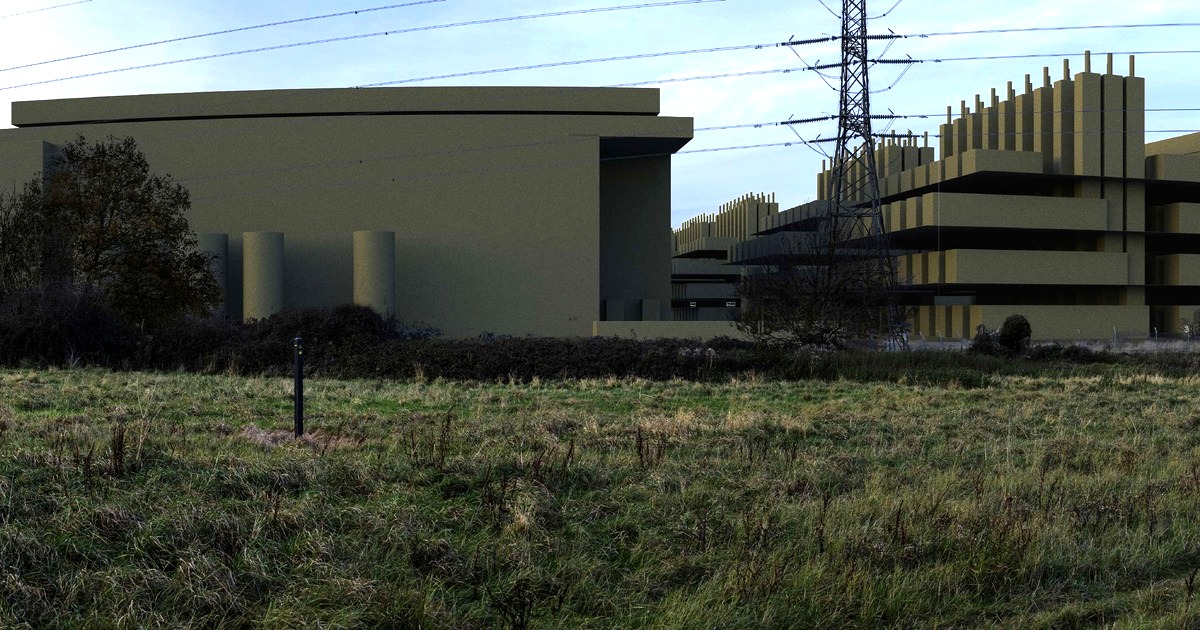
The last industrial revolution filled south Wales with works that employed thousands. The next one is arriving as vast sheds full of computers, and it wants the same ground.
At Bridgend, the Ford plant that built engines until 2020 has consent to become a data centre campus four times the size of Europe’s biggest. At Margam, a data centre approved in May will run on the biomass power station next door.
Behind the boom is artificial intelligence. Every question typed into a chatbot is answered inside a building like these, and the race to build enough of them has made data centres some of the most sought-after developments in Britain.

Ministers lean into the echo of the coal and steel age. Announcing the growth zones that brought the boom to Wales, the then technology secretary Peter Kyle called AI “this generation’s next great industrial leap”, and the UK Government argues the zones channel investment into post-industrial towns with energy capacity to spare.
The 10,000 electricians question
There is a catch, and it lands on the tradespeople who wire your school and fit out your hospital.
Wales has attracted 13 per cent of Britain’s data centre applications since the start of 2024 but is home to just 4 per cent of its electrical installers, around 10,000 people, according to analysis by Horizon Platforms, an access equipment firm that supplies the trades building these sites.
Matching Wales’s share of the pipeline would imply 22,000 more electricians than the country has. The firm stresses that is a comparison rather than a hiring forecast, but its conclusion is blunt: “The big question is, though, who is going to build them?”
There is no dedicated data centre workforce. The same electricians and cooling engineers are already fitting out hospitals, schools, offices and shops, and if several sites start at once, the firm says, crews are likely to be brought into Wales from elsewhere.
From engine plant to engine room
The biggest site of all sits on Bridgend’s industrial past. Vantage Data Centres bought the 1.7 million square foot former Ford engine plant at Waterton and won consent last October for a campus of ten data centre buildings and three substations.
The company’s plans say the campus will be “approximately four times the capacity and size” of its Newport site, which Senedd researchers already describe as the most powerful data centre campus in Europe.
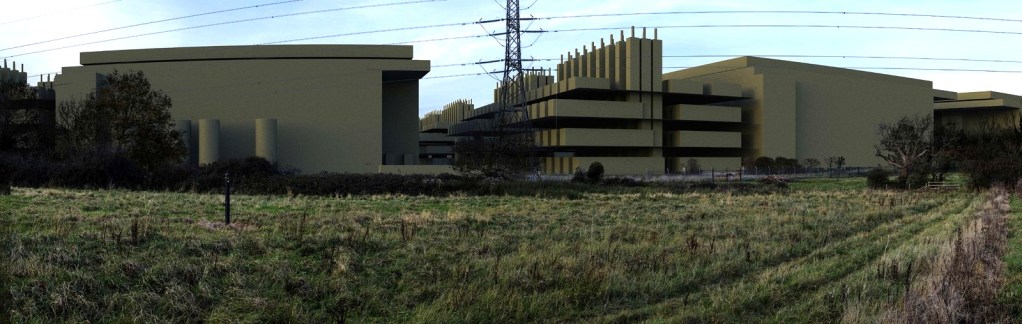
Council leader John Spanswick says the investment will put Bridgend “at the centre of future AI development in the UK”, with up to 5,000 jobs claimed, from construction through to careers in AI. Two smaller data centres already operate in the county, according to industry directories.
Margam’s scheme is the boom in miniature, and the cleverest of the lot. Western Bio-Energy won permission from Neath Port Talbot Council in May for a 12 megawatt data centre at Tyn-y-Caeau, off junction 38 of the M4, drawing its power through a private wire from its own biomass plant next door and skipping the queue for a grid connection.
What the sheds drink and burn
All of it comes with a bill measured in megawatts and litres. Data centres already use around 1.8 per cent of Great Britain’s electricity, Senedd researchers say, and Wales’s entire fleet drew 154 megawatts in 2024. The schemes now in the pipeline would multiply that many times over.
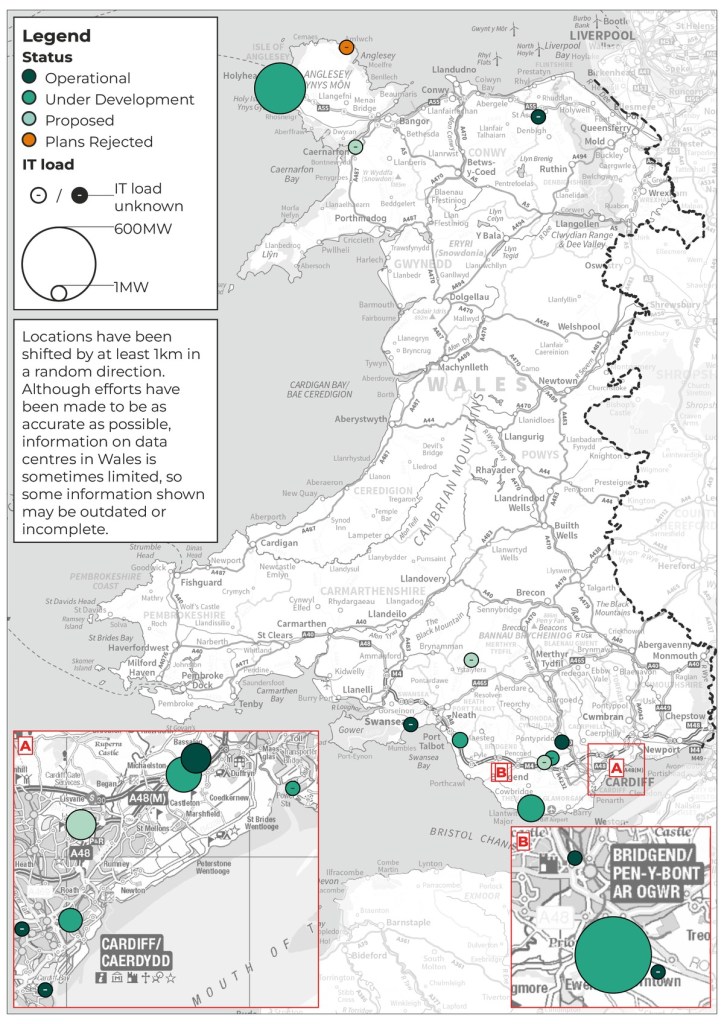
One proposed campus on Cardiff’s eastern edge would need around 150 megawatts on its own, equivalent to all of Wales’s solar generation capacity in 2024.
The AI machines run hot, and cooling them increasingly means water. Natural Resources Wales declared the whole country in drought in July, the driest in 190 years of records, and a hosepipe ban covered 33,000 properties across Ceredigion, north Pembrokeshire and north Carmarthenshire.
Senedd researchers cite estimates that users of one AI model alone consumed more water in a year than 1.2 million people drink.
The industry’s own paperwork concedes the point. Plans for the Bridgend campus record that water companies have confirmed the local supply has “limited capacity to serve the development”, with a reinforcement scheme to be delivered if necessary before any building opens.
Operators promise green credentials, with Vantage’s plans aiming for net zero operational carbon at Bridgend by 2030 and Microsoft matching its Newport site’s grid power with renewable energy deals. Senedd researchers note the pressure runs the other way too: cooling gets harder as heatwaves intensify, and data centre failures have already hit NHS hospitals in hot weather.
‘A lifeline’, two petitions and a refusal
Communities are pushing back. Residents fighting the Cardiff campus say the 900-space park and ride it would replace was a “lifeline” to the University Hospital of Wales, though their petition to the Senedd was rejected as a matter for the local authority, and another petition opposes a data centre at Pontyclun.
Councils can say no. Anglesey refused an AI data centre at Amlwch’s former bromine works in April, a rare rejection in an industry where analysis suggests 97 per cent of UK applications are approved.
The boom Swansea is still waiting for
Swansea, the city that once smelted the world’s copper, has yet to see a single scheme lodged. The port-side energy project once branded Blue Eden lists a data centre alongside its tidal lagoon and battery plant, but only on paper.
At Felindre, where 2,500 people once made tinplate, the cleared site’s industrial-era power supply has drawn “repeated interest” from data centre firms. Council leader Rob Stewart is unconvinced, telling a scrutiny panel in June that data centres “don’t tend to create a huge amount of jobs”.
That is the question the new industrial revolution has not yet answered for Wales: the last one employed whole towns. “We don’t just want to host hard infrastructure, we want to get the benefit of it,” Adam Price, the Cabinet Minister for Enterprise, Connectivity and Energy, told the Senedd.

Discover more from Swansea Bay News
Subscribe to get the latest posts sent to your email.