



A hosepipe ban comes into force across parts of west Wales at 10am on Sunday, Welsh Water has confirmed — covering around 33,000 properties, including communities in north Carmarthenshire and north Pembrokeshire.
The move was signalled on Friday, when the company warned restrictions were likely this weekend — and the ban has now been formally announced under a public notice issued on Saturday.
But the company says this is not a traditional drought ban: its reservoirs are not running low.
Instead, Dŵr Cymru Welsh Water says the problem is the pace of demand — its treatment works cannot make clean drinking water quickly enough to keep up with what customers are using during the prolonged hot spell.
“Unlike a traditional drought-related hosepipe ban, this is a demand-led, short-term measure,” the company said, designed to reduce peak use, ease pressure on the local network and keep supplies reliable while the hot weather lasts.
In Carmarthenshire, the ban covers Farmers, Pencader and Hermon — while the wider affected area also takes in Llandysul and stretches towards Newcastle Emlyn on the county’s northern edge.
In Pembrokeshire, the communities affected are Crymych, Eglwyswrw, Nevern, Newport, Llanfyrnach, Tegryn and Star.
The bulk of the ban area lies across mid and south Ceredigion, including Aberaeron, New Quay, Lampeter, Tregaron, Llandysul and Aberporth — with Welsh Water publishing a postcode checker so customers can confirm whether their property is included.

Under the ban, hosepipes — including sprinklers, dripper hoses and automatic irrigation systems — cannot be used to water gardens or plants, clean cars, boats, windows, paths or patios, or to fill paddling pools, ponds, fountains or hot tubs, with filling a hot tub classed as recreational use under the notice. Water slides are also covered — and the vehicle ban extends to taxis and minicabs, which count as private motor vehicles.
The same jobs can still be done with a bucket or watering can — and water that does not come from the mains, such as rainwater from a water butt or a private borehole, can still be used through a hosepipe.
There are exceptions: Blue Badge holders and customers on Welsh Water’s Priority Services Register who cannot safely follow the ban for health reasons can continue using a hosepipe without seeking permission.
Newly laid turf can be watered by hosepipe for its first 28 days, trees and hedging planted within the last three years are exempt where a watering can is not reasonable, and the same applies to food crops — while businesses cleaning cars, windows or boats as a service to customers can carry on.
Among the more unusual exceptions: a hosepipe can be used to remove graffiti from a home where the graffiti is a hate crime or offensive — and pools and fountains at places of worship can be filled when used as part of a religious ceremony.
The hosepipe ban at a glance
| ❌ Not allowed with a hosepipe | ✅ Still allowed |
|---|---|
| Watering the garden, lawn or plants — including sprinklers and irrigation systems | Watering with a bucket or watering can |
| Washing the car — including taxis and minicabs | Washing the car with a bucket and sponge, or paying a business to do it |
| Cleaning windows, walls, paths, patios or decking | Cleaning them with a bucket — or a window cleaner doing it as a business |
| Filling paddling pools, swimming pools, hot tubs or water slides | Topping up a fish pond to keep fish healthy |
| Filling ponds and ornamental fountains | Rainwater from a water butt — through a hosepipe is fine |
| Using a hosepipe connected to the mains for any of the above | Grey water, borehole water — and hosepipe use by Blue Badge holders and Priority Services customers who need it |
The area’s network is supplied by the Teifi Pools reservoirs on the western edge of the Cambrian Mountains and water taken from the River Teifi at Llechryd — and the company says moving water in from other parts of Wales is not practical because of the terrain and the cost of pumping large volumes across country.
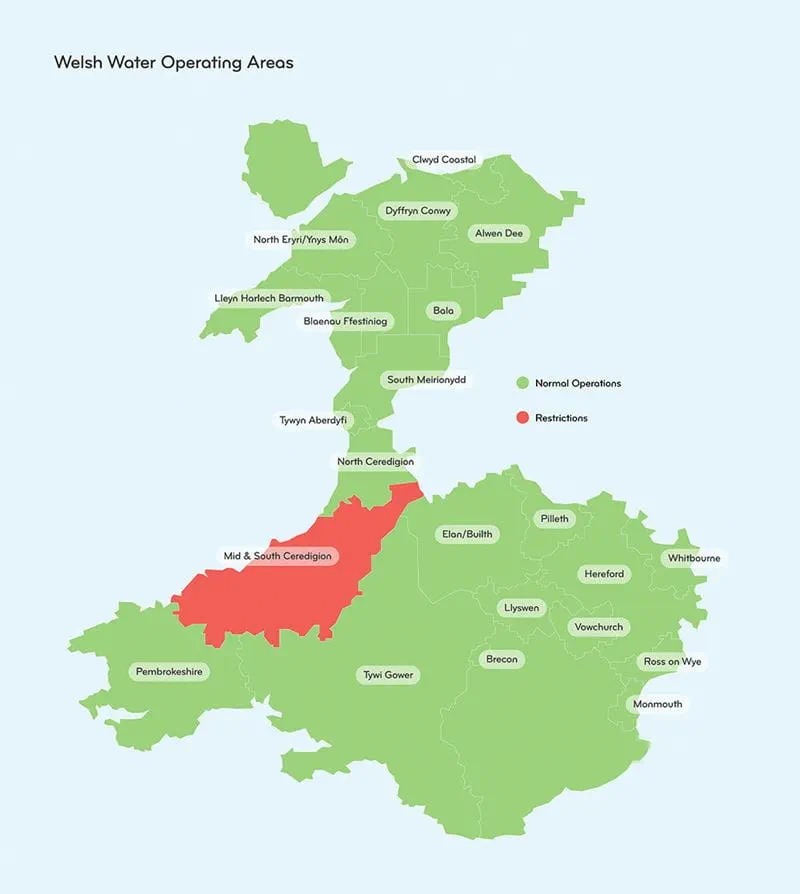
Demand has stayed significantly higher than normal for several weeks, it says, despite treatment works running at maximum capacity — with the pressure sharpest during the busiest parts of the day, when local storage tanks cannot refill fast enough.
The company says its teams are currently fixing around 700 leaks a week across Wales, with rezoning and tankers being used to move water into high-demand areas and production increased at treatment works.
The restrictions are described as a temporary emergency measure, to be lifted “as soon as temperatures fall, demand returns to more normal levels and the network is operating sustainably again”.
The prohibitions take effect under sections 76 and 76A–C of the Water Industry Act 1991 and remain in force until further notice — with anyone wanting to make formal representations against them needing to write to the company or email water.resources@dwrcymru.com by 9am on Sunday, one hour before the ban begins.
The company thanked customers for the efforts already made, saying that by avoiding non-essential use, “customers can help protect supplies for everyone during this exceptional period”.
Anyone unsure whether their property is affected can check their postcode at dwrcymru.com/en/drought/hosepipe-ban.
Discover more from Swansea Bay News
Subscribe to get the latest posts sent to your email.