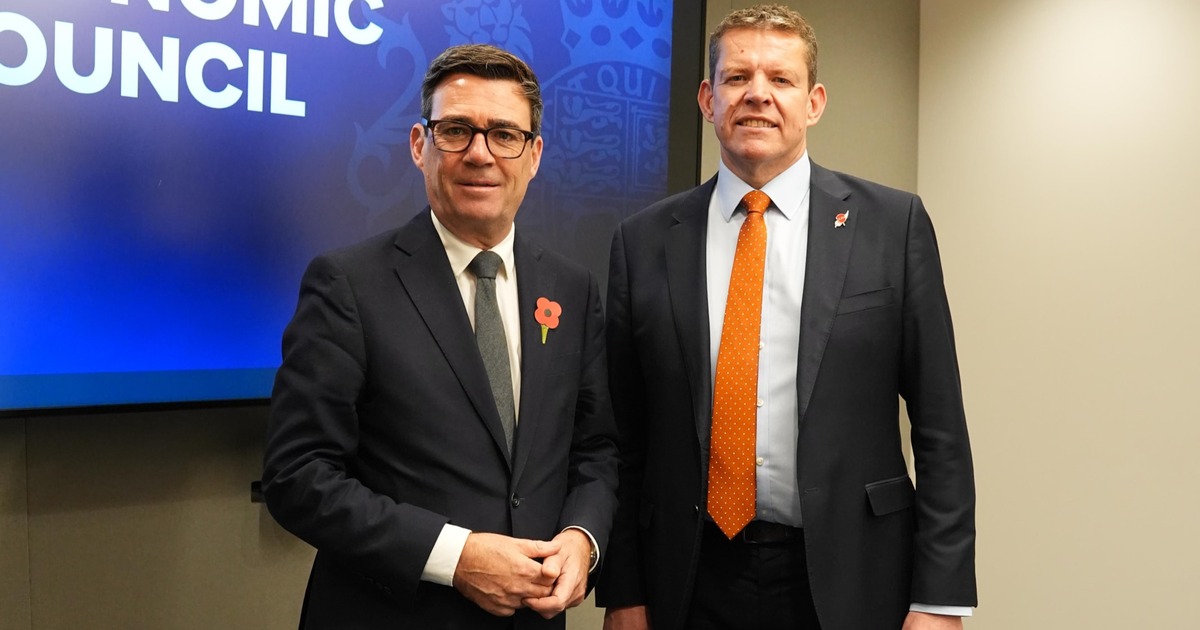
The seabed off the south west Wales coast, the police forces that patrol the area and the railway through Swansea will all stay under Westminster’s control, after the Prime Minister turned down the Welsh Government’s request to take them over.
Andy Burnham told the First Minister in a letter on Friday that he was “not persuaded” by the case for devolving policing, the Crown Estate or rail infrastructure, and that the justice system should stay shared with England.
Rhun ap Iorwerth has written back to say he is “deeply disappointed and surprised”, and has asked for an urgent meeting.
He told Senedd members the refusal “proves that the Prime Minister does not view Wales as an equal nation”.
It is three weeks since the two met in Glasgow, when the First Minister came away saying more tax powers for Wales were “a matter of how and when”.
Burnham says the Crown Estate should keep the Celtic Sea seabed
The Crown Estate looks after the seabed and is leasing parts of the Celtic Sea for floating wind farms.
The owner of Port Talbot’s docks wants those structures built and put together in the town.
The Welsh Government wants the estate run from Wales, as it already is in Scotland, so that decisions about Welsh natural resources are taken here.
Burnham’s answer was that the current model “provides the best means of maximising the economic and social benefits for Wales”.
He said its scale and financial capacity support long-term investment, and that the link with England is “crucial for investors” in floating wind. He ruled out preparing for a handover at a later date as well.
South Wales and Dyfed-Powys policing stays with Westminster
On policing, the Prime Minister said he wants the Welsh Government to play “a clear role” in how forces are governed, but without changing the law to hand it control.
He said a single England and Wales system lets forces work across the border and call on national and specialist units, and that separating Wales would create “new operational and constitutional boundaries”.
It means South Wales Police and Dyfed-Powys Police stay part of that system.
The First Minister had argued that more than half of police funding in Wales already comes from devolved sources. He said the mayors of London and Greater Manchester have more control over justice than the national government of Wales.
Great British Railways, not Cardiff, to look after Welsh track
Track and stations in Wales would be funded and delivered by the new Great British Railways, working with Transport for Wales.
Burnham said so much of the Welsh network crosses the border that full devolution “would fragment the current system”.
He pointed to a pipeline of Welsh rail projects valued at up to £14bn, and said decisions on upgrades are being moved to the Wales Rail Board.
Ap Iorwerth sends Burnham three reports and asks him to read them
In his reply on Monday, the First Minister said the Prime Minister’s letter “appears largely to rest on the long-established positions” of the Whitehall departments that hold the powers now.
He has enclosed three independent reports that back handing them to Wales, among them the Commission on Justice in Wales chaired by former Lord Chief Justice Lord Thomas, and asked Burnham to “consider their findings personally”.
He wrote: “Wales should not be required to meet a different or higher threshold for devolution.”
The First Minister also quoted Burnham’s own pledge back to him, that “the days of Whitehall fighting the devolution of power into the regions and nations are over, for good”.
And he said the Prime Minister’s position was “at odds with the views of many of your party colleagues in Wales”, adding that he intends to work with them on a cross-party basis.
What Burnham did offer: money, probation and jobs support
The Prime Minister’s letter lists what the UK Government is spending in Wales: £2.5bn on nuclear power on Ynys Môn, £500m towards the electric arc furnace in Port Talbot and £445m for rail.
He said a further £450m is going to the Welsh Government after the Budget.
Burnham proposed looking at how more employment support could be devolved, with responsibility reaching “Wales’s regions and communities”. He said ministers are also exploring “a bigger and clearer role” for Wales in funding and overseeing probation, and a wider one in youth justice.
Talks with the Treasury on looser rules for the Welsh Government’s finances are continuing. The First Minister called that “a step forward” and has asked for the new arrangements to be agreed immediately.
Skates wants talks to go on, Davies says Burnham got it right
The leader of Welsh Labour has urged both governments to keep talking.
Ken Skates, the Fflint Wrecsam MS, said: “You negotiate around a table. And you don’t walk away when work needs to continue.”
He said his party still backs further devolution, and that on policing he wants “greater detail over why full devolution is not happening as part of the current reforms”.
Skates said he is speaking with the Prime Minister and will be meeting him. “This agenda is too important to be confined to an exchange of letters,” he added.
He said Welsh ministers should not walk away from what was offered on employment support, youth justice and probation, and that Labour’s focus was “not on acquiring powers for their own sake”.
Andrew RT Davies, the Welsh Conservative MS for Pen-y-bont Bro Morgannwg, said the Prime Minister was right to refuse.
He said he had been “very critical” of Burnham on other issues, and it was “only right to praise him when he does something good”.
Davies said health and education had “performed far worse than England under the Senedd’s control”, and that Plaid should “focus on the day job”.
He added: “More powers is the last thing Plaid Cymru separatist ministers need.”
The First Minister is due to make a statement to the Senedd on Tuesday.

Discover more from Swansea Bay News
Subscribe to get the latest posts sent to your email.