


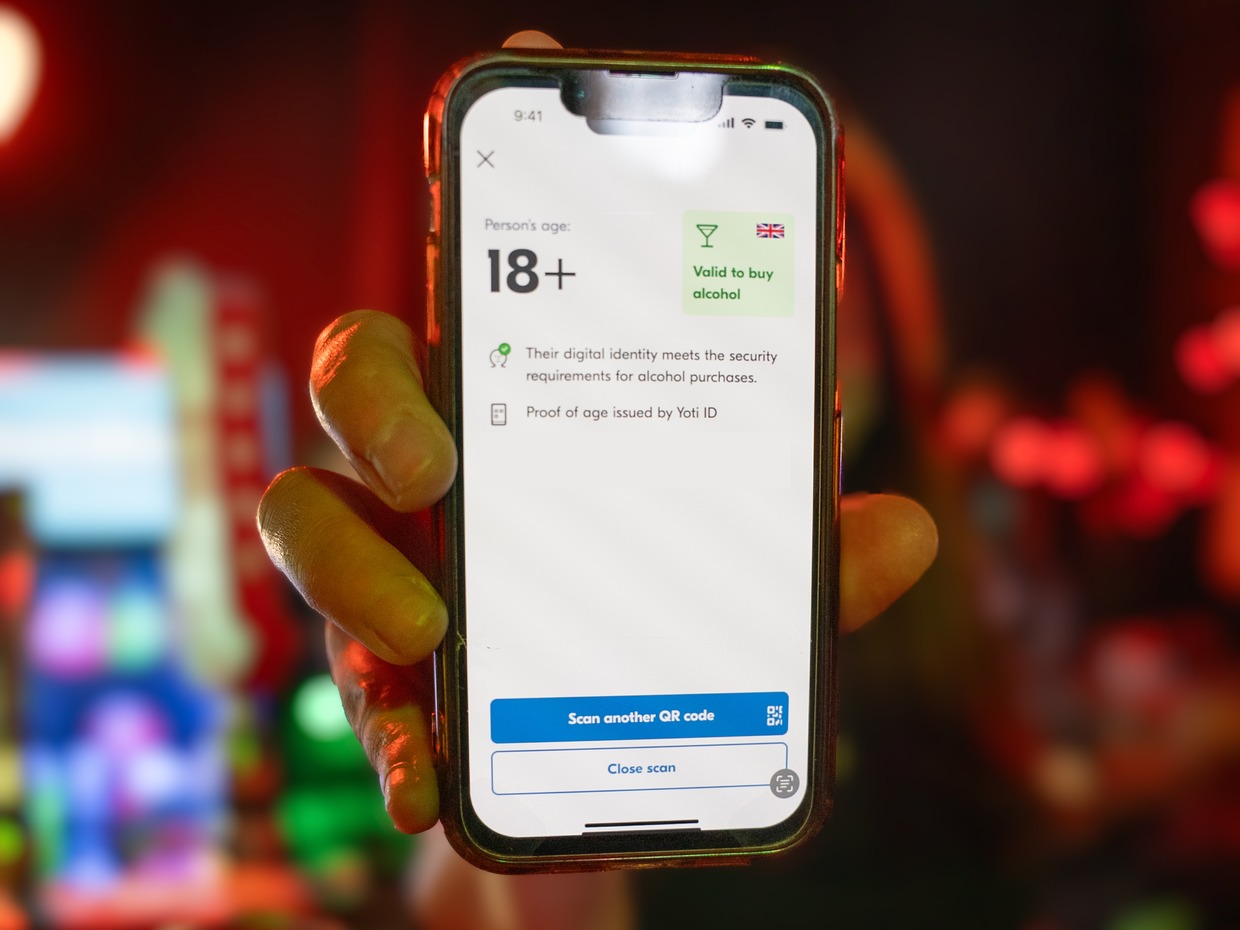
From today you can prove you are over 18 at the bar with your phone, without handing over your name or your home address.
New rules covering England and Wales let licensed premises accept certified digital proof of age for alcohol sales. Physical ID stays valid everywhere, and it is up to each business whether to take the digital version.
The catch is timing. The Department for Science, Innovation and Technology says it will take businesses time to adopt it, so it is worth keeping the driving licence in your pocket a while yet.
How it would work at the door
Where a venue has signed up, it could be as simple as showing a QR code for staff to scan, or tapping a phone against a compatible reader. Staff get a confirmation on their own device that the check has passed.
The apps are third-party services certified under the UK’s digital verification framework. Yoti, Post Office EasyID and Luciditi are among those named.
The pitch is that the customer hands over less. Instead of a driving licence carrying a name and a home address, the venue sees only that the person is over 18.
DSIT also argues it is harder to fool, because a certified service checks that an ID is genuine and belongs to the person presenting it, rather than leaving bar staff to spot a fake.
Wales reacted harder than anywhere last time
There is a reason to be careful about predicting how fast people take this up, and it is a Welsh one.
When the Online Safety Act forced age checks onto porn sites in July 2025, VPN searches jumped 589% in Wales, the sharpest rise anywhere in the UK. England’s rose 99%.
The objection then was trust rather than the checks themselves. Children’s safety group Internet Matters said at the time that people simply did not trust the systems being introduced.
The two are not the same thing. Those checks meant uploading ID or submitting to a facial scan on an adult site. This asks for less, through a certified provider, ending in a bar worker seeing a pass or a fail. But it is the same government asking the same public to prove its age digitally, and the last attempt did not land well here.
What it does not change
Digital Government Minister Stephanie Peacock said it would remain a choice for individuals and businesses alike, with physical ID still valid.
“This groundbreaking change in the law will mean you do not need to carry a physical ID, nor hand over sensitive personal information such as your name or address just to prove your age, allowing everyone to feel safer on a night out,” she said.
It does not change the legal drinking age, or the duty on businesses to prevent underage sales. Nothing in the rules obliges a venue to accept a phone.
It is also separate from the government’s digital driving licence and the GOV.UK Wallet, though DSIT says that may in time become one of the ways people prove their age.
UKHospitality chief executive Allen Simpson called it a positive step, adding that the trade would work with government to make sure the rollout “is cost-efficient and not burdensome for the hospitality sector”.
The change follows a 2024 consultation in which 72% of respondents backed the use of digital identities for age verification when buying alcohol. Until venues actually start taking it, the most reliable thing in your pocket on a night out is still the card with your face on it.
Related stories from Swansea Bay News
VPN searches surge in Wales as UK porn age checks spark privacy backlash
Wales recorded the sharpest rise in the UK when age checks arrived on adult sites.
OPINION: Kirstie Logan-Townshend on the Online Safety Act
A Swansea consultant and former government adviser on why the Act was built to fail.
Discover more from Swansea Bay News
Subscribe to get the latest posts sent to your email.