Up to 400 new homes could be built on the site of Gorseinon’s former 3M factory, under early plans lodged with Swansea Council.
Developer Walters has asked the council for pre-application advice on demolishing what remains of the plant and redeveloping the land off Gorseinon Road, between Gorseinon and Penllergaer — the first formal step before a full planning application.
A vision document drawn up with architects Hammond Architectural sets out what the developer calls a “residential-led” neighbourhood combining homes, workspace, a community hub and green space on the brownfield site.

The sprawling plant was 3M’s oldest manufacturing site outside the United States, opening in 1952 and turning out everything from aerosols and adhesives to personal care products.
It closed in 2021 with the loss of 89 jobs, when the American giant moved production to sites including Bangor in Northern Ireland.
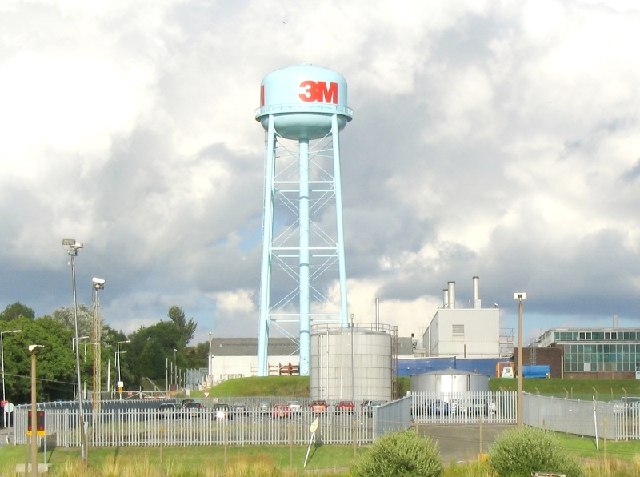
Much of the factory has since been cleared — demolition plans lodged in 2023 took in nine buildings and structures, including the site’s landmark water tower.
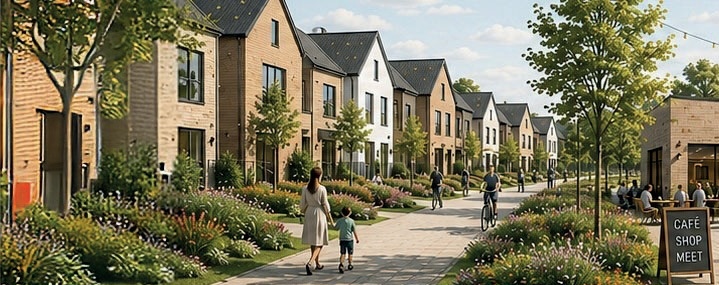
The new homes would be arranged around green streets and public open spaces, with around 1.5 hectares set aside for employment space alongside the businesses already operating on part of the site.
Half a hectare at the heart of the site is earmarked for a community hub that could take in community facilities, local services and small-scale shops — though the document says that depends on “future need and viability”.


Woodland open space, a greenway along the site’s embankment, a games area and drainage ponds feature in the layout, with access off Gorseinon Road and walking and cycling links to nearby bus stops and shops.


The document is frank about the hurdles: contamination from seven decades of industrial use will need investigating and cleaning up, the site’s steep level changes complicate the layout, and noise from neighbouring industrial units will need managing.
The plans are indicative at this stage — the document notes the layout and figures are “for discussion purposes and subject to ongoing technical assessment and masterplanning”.
But those 400 homes would not be arriving in an empty landscape. Few corners of Swansea are already building — and arguing over — more housing than this one.

Almost opposite the lower end of the site, Persimmon is building Garden Village — reviving a model community first conceived in the early 1900s and halted by the First World War. By last autumn just 24 of its allocated 700 homes had been built, after ancient woodland concerns forced a public inquiry — but the pace has since picked up.
Persimmon is now down to its last three homes in the 86-home first phase, marketed as Cwrt y Brenin — and has started selling a second, 110-home phase, Llys Pentre, at the far end of the vast site, where plans show a proposed primary school, playing pitches and a commercial unit.
Even the housing association sector has a stake in the same patch: land at the edge of the Persimmon site is marked for future development by Beacon — which, as Coastal Housing before its merger with RHA Wales, revealed plans for a 17-home development in Garden Village.
Alongside the site off Llewellyn Road, Barratt’s Pentref Llewelyn — named for Penllergaer’s pioneering astrophotographers John and Thereza Dillwyn Llewelyn, with Thereza believed to have taken the first known photograph of the moon — is all but sold out. Only the show home remains on the market, though Barratt’s premium David Wilson Homes brand is still selling on its half of the site, after the first homes sold within days of release.
Opposite that, Bellway’s Parc Mawr is furthest along — just one home is left on the market in its 184-home first phase, from 644 allocated across the wider site. Campaign group Preserve Penllergaer fought the allocation from the start, warning the promised primary school and relief road might never materialise.
The demand question answers itself: between them, the Persimmon, Barratt and Bellway phases ringing the 3M site have just five homes left to sell. Delivery is another matter — Swansea’s Local Development Plan promised more than 7,000 homes on its strategic sites within five years, and six years on fewer than 300 have been built.
To the south, the corridor between Penllergaer, Gowerton, Waunarlwydd and Fforestfach has become the county’s fiercest planning battleground. Campaigners warned a “continuous ribbon of housing” could stretch from Penllergaer to Gowerton when Persimmon unveiled a 600-home scheme there.
In Gowerton itself, the decade-long fight over 216 homes at Fairwood Terrace is now in the hands of a Welsh Government inspector, after councillors refused the scheme against their own officers’ advice and nearly 600 local submissions poured in. The appeal has already been dealt a blow by an order for a full environmental assessment.
Another scheme would put 230 homes near Gowerton train station. A major housing application has been lodged in Fforestfach too.
The boom runs on to Pontarddulais, where Persimmon has plans for a 500-home “zero-carbon ready” neighbourhood — approved in principle, not yet started. Another 95 homes are proposed on farmland there. A 30-home housing association scheme is also on the table.
It is not the group’s first go at giving worked-out industrial land a second act. Walters remediated and masterplanned the former Ffos Las opencast mine near Trimsaran — which the company has described as one of Europe’s deepest opencast excavations — delivering Ffos Las racecourse in 2009, the first purpose-built racecourse in Britain since 1927, with the housing handed to major builders Persimmon and Dandara.
Any full application will also run into the environmental rules now slowing schemes across north-west Swansea. Natural Resources Wales has ruled the Burry Inlet is in “unfavourable condition”, meaning larger developments in the catchment must prove they will not add nutrient pollution — a test that has already put major applications on hold, alongside national rules requiring flooding and drainage to be weighed for all new Welsh developments.
Then there are the roads. Junction 47 of the M4 — the area’s main pinch point — already operates beyond its design capacity, and Penllergaer Community Council has branded the development plan’s failure to deliver transport infrastructure “abysmal”. When a giant distribution warehouse was approved nearby in March, it came with a condition that £790,000 of junction works must be finished before it can even open. That was despite an earlier traffic light upgrade at the roundabout.
The 3M site does at least start from a different place to the green fields that have drawn the fiercest objections: it is brownfield land, and not the area’s only former factory getting a second life — along the road, the old Toyoda Gosei car parts plant is being converted into a plastics recycling centre due for completion by 2028.
As a pre-application enquiry, no decision has been made, and public consultation would follow any full application. The bigger question — where Swansea puts its next decade of homes — will be settled by the replacement development plan, with a detailed version due to be published this year.
Related stories from Swansea Bay News
7,000 homes promised, just 300 built: Swansea’s housing blueprint falters
Our in-depth look at why delivery on the county’s strategic housing sites has stalled.
GOWERTON: The decade-long fight over homes, schools and mine shafts
The Fairwood Terrace saga now rests with a Welsh Government inspector.
Continuous ribbon of housing could stretch from Penllergaer to Gowerton
Campaigners’ warning as a 600-home scheme was unveiled between the two communities.
PENLLERGAER: Giant distribution warehouse approved next to M4
The decision that hinged on whether Junction 47 can cope with any more traffic.

Discover more from Swansea Bay News
Subscribe to get the latest posts sent to your email.