



Imagine getting a tram from Aberdulais into the middle of Swansea.
It would run on ordinary railway track up the Neath valley, then onto street track through the city centre, the same trick Cardiff already pulls on its Metro. A vehicle that works as both a train and a tram is called a tram-train.
The route has been drawn. Eleven stops: Swansea High Street, College Street, the Strand, Port Tennant, Langdon, the University’s Bay Campus, Bay Studios, Jersey Marine, Llandarcy, Neath Abbey and Neath Riverside, with an extension on to Tonna or Aberdulais.
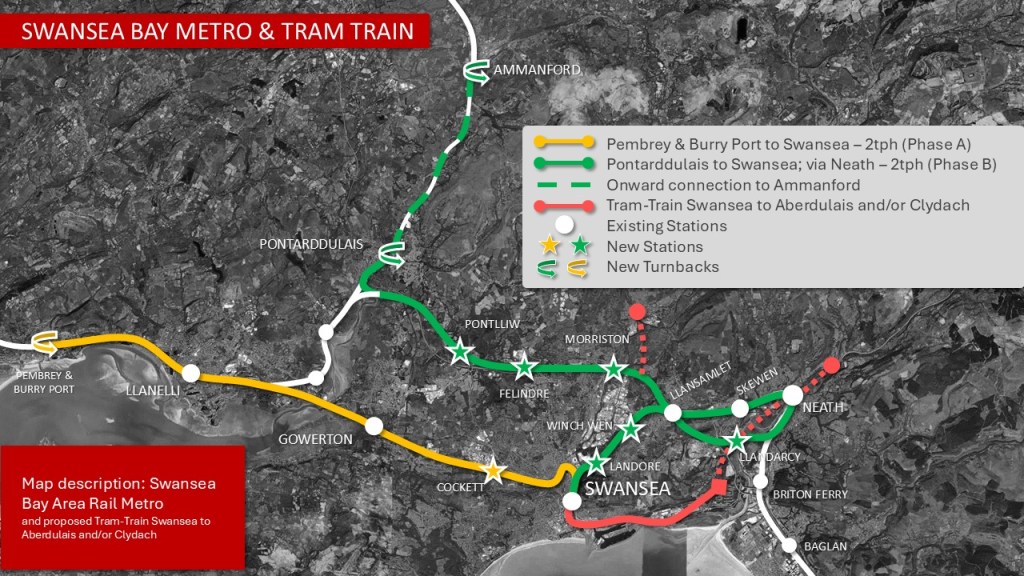
A train every half hour. A forecast 2.2 million journeys a year, the busiest stops being College Street and the Strand.
It is not a new idea. Welsh Government studies in 2020 and 2021 assessed it, scored it and recommended it be taken forward.
Nobody has committed a penny to building it.
The vote, and the answer
Last December every councillor in the Neath Port Talbot chamber backed a motion by Green councillor Nathan Goldup-John called From Gridlock to Growth. It asked officers to come back on commissioning a feasibility study for a valley-to-city tram-train, and it passed unanimously, with a report due within that financial year.
The report has arrived six months late, and its answer is no.
“Cabinet is not being requested to commission a new feasibility study at this stage,” it says, because the work has already been done, and anything more “would need to be led by Transport for Wales and regional partners”.
Cabinet is asked instead to note the report, acknowledge the scheme’s merit while noting its “significant cost, deliverability and regional dependency considerations”, back continued officer talks with Transport for Wales, and back officers looking for other sources of money.
What the sums said
Transport schemes in Wales are scored with a benefit-cost ratio, a number weighing what a scheme is expected to deliver against what it costs. Above 1.0 and the benefits outweigh the costs.
The Swansea to Neath line scored 1.9, and was recommended for further development. Capital cost at 2021 prices was £360m, or £507m once risk was added.
The valley extensions in the motion did not fare as well. Lines from Neath Riverside up to Onllwyn and to Cwmgwrach both scored 0.5, and neither was recommended. The report says the reason is low forecast demand north of Aberdulais.
The study the public has not seen
More recent work exists. Transport for Wales commissioned a study in 2023 on exactly how a tram-train would thread from Swansea High Street through the city centre, SA1 and the Bay Campus to Jersey Marine, near the Towers Hotel.
The report calls it “the most detailed technical work to date”, then adds that it “is yet to be subject to public consultation”.
A Neath Port Talbot motion for a scheme built mostly in Swansea
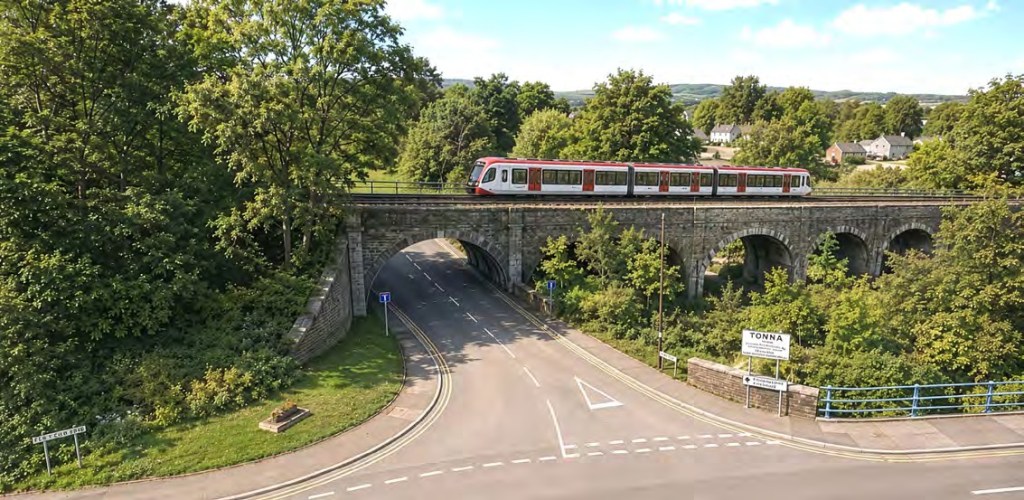
The line from Jersey Marine up to Aberdulais already exists, but carries only freight, and would need upgrading with new stations built along it.
The hard part is at the other end. “In delivery terms, the proposal is therefore largely Swansea-based,” the report says, with the tram building work “predominantly within Swansea City Centre” and Swansea Council needing to play a key role in anything that follows.
Third in a queue, in the bigger of two pots
The tram-train is Phase C. Phase A is a new station at Cockett and more trains to Pembrey and Burry Port. Phase B opens the Swansea District Line, the freight railway that loops north of the city, to passengers with up to seven new stations, plus a new piece of track at Cwrt Sart to join it to the main line. Design work on A and B is finished, bar Ammanford.
Transport for Wales priced the Swansea to Neath and Tonna expansion at over £1 billion in February, and put it in its larger £10 billion funding scenario, which the council report describes as “not a committed delivery programme”.
Nor is the money Cardiff’s to give. The report notes funding for rail infrastructure sits with the UK Department for Transport and the Treasury, with the Wales Rail Board deciding how Welsh schemes should be ranked for future UK funding.
There is not much money to be visible for. The region’s four councils share £24.7m of Welsh Government transport funding this year, spent on flood work, a bus and rail interchange at Llanelli and two stretches of path. Officers told the regional joint committee ten days ago that the pot “is not sufficient for the region to achieve its ambitions”, and that the Welsh Government had told them to expect a flat budget next year.
Neither St Clears station nor the Swansea Bay Metro won anything in the last UK Spending Review, Transport for Wales told councillors in July. The next one is in 2027.
Officers’ own risk line is that the scheme “may not progress in the short to medium term”.
Friday
Cabinet members were briefed privately on 2 September. Scrutiny takes it at 10am on Friday 18 September, in the presentation room at Port Talbot and on Teams, webcast on the council’s website. Cabinet decides on 30 September.
Related stories from Swansea Bay News
Councillors back bold plan to explore Swansea Valley tram-train link
The motion that started it, passed unanimously last December.
SWANSEA BAY METRO: Every new station and tram line now has a price tag
What the whole Metro would cost, and what the region actually has to spend.
METRO ROW: Carmarthenshire councillor blasts ‘Swansea-centric’ transport vision
The argument about who the Metro is really for.
More on the Swansea Bay Metro
Every story on the region’s rail plans.

Discover more from Swansea Bay News
Subscribe to get the latest posts sent to your email.