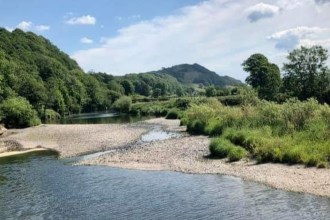
High on Dinas Hill, where the Towy bends through the hills north of Llandovery, a cave hides among the oaks that once sheltered the closest thing Wales has to Robin Hood.
The difference is that ours was real. Twm Siôn Cati, plain Thomas Jones in the records, left a royal pardon, poetry, genealogies and letters behind him, much of it now held at the National Library of Wales.
Jones was born around 1532 at Fountain Gate, or Porth y Ffynnon, near Tregaron, just over the Carmarthenshire border in what was then Cardiganshire. Twm Siôn Cati means Tom, son of Siôn and Cati, his father John and mother Catherine.
It was the upper Towy valley that gave him his legend. The stories have him hiding from the Sheriff of Carmarthen in the cave on Dinas Hill, a natural lookout over the river where pursuers could be watched winding up the slopes long before they arrived.
The tales that grew around him are pure folk hero. He is said to have fired arrows so precisely they pinned a traveller’s cloak to his saddle without drawing blood, and to have robbed the rich with such courtesy that his victims half admired him.
In the best-known story, a farmer who swore to catch him came knocking at his mother’s door. A ragged beggar offered to hold the man’s fine mare while he went inside, then leapt into the saddle and rode off, stopping at the farmer’s own house to collect a purse of gold from his unsuspecting wife.
How much of that is true is anyone’s guess, and scholars suspect the tales are really a composite, the deeds of several raiders around Tregaron folded into one irresistible name. What the record shows about the real Thomas Jones is remarkable enough.
A document from 1559 names “Thomas Johns alias Catty” among those granted a general pardon in the first year of Elizabeth I’s reign, the paperwork behind the legend of the outlaw who came in from the cold. Some accounts have the young Protestant fleeing to Geneva while the Catholic Mary I was on the throne, with Elizabeth’s accession opening the way home.
The pardoned man became a respected antiquary, genealogist and bard, good enough that the Tudor polymath John Dee, astrologer to the Queen, called him “my cousin” and corresponded with him, according to the Dictionary of Welsh Biography.
In 1607, late in life, he married Joan, the widow of Thomas Williams of Ystradffin, the farm at Rhandirmwyn a short walk from his legendary cave. The outlaw of the stories ended his days a landowner on the very ground he was said to have hidden in, dying in 1609. His will was proved at Carmarthen.
Tradition adds that he rose to become a magistrate and even mayor of Brecon, the fugitive turned enforcer of the law, though the historians are more cautious than the storytellers on that.
The Robin Hood framing came much later. Tales of Twm circulated in print from the 1760s, but it was T.J. Llewelyn Prichard’s 1828 novel The Adventures and Vagaries of Twm Shon Catti that turned him into a national folk hero, and generations of Welsh children met him again in T. Llew Jones’s classic retellings.
The cave is still there, and the walk to it makes a free day out this summer. Dinas Hill is part of the RSPB’s Gwenffrwd-Dinas nature reserve near Rhandirmwyn, reconnected last month when the charity bought the 96-hectare missing link between its two halves, and the reserve is open dawn to dusk with free entry and a suggested £1 donation for parking.
A two-mile circular trail starts from the car park with a stretch of boardwalk before following the riverbank through the oak woods, with a short, steep scramble branching off up to Ogof Twm Siôn Cati itself. Red kites, dippers and grey wagtails are regulars along the river, with pied flycatchers and redstarts about in summer.
It is a proper walk rather than a stroll: parts of the riverside path are rocky and slippery, sturdy footwear is the RSPB’s advice, and there is no cafe on site, with the nearest food at the Towy Bridge Inn a couple of miles back down the road. The reserve is about ten miles north of Llandovery, signposted from the Rhandirmwyn road towards Llyn Brianne.
Visitors who make the climb will find the cave walls carved with centuries of names, including members of the Pembrokeshire Yeomanry who rode up on horseback to leave theirs with bayonets shortly before the First World War.
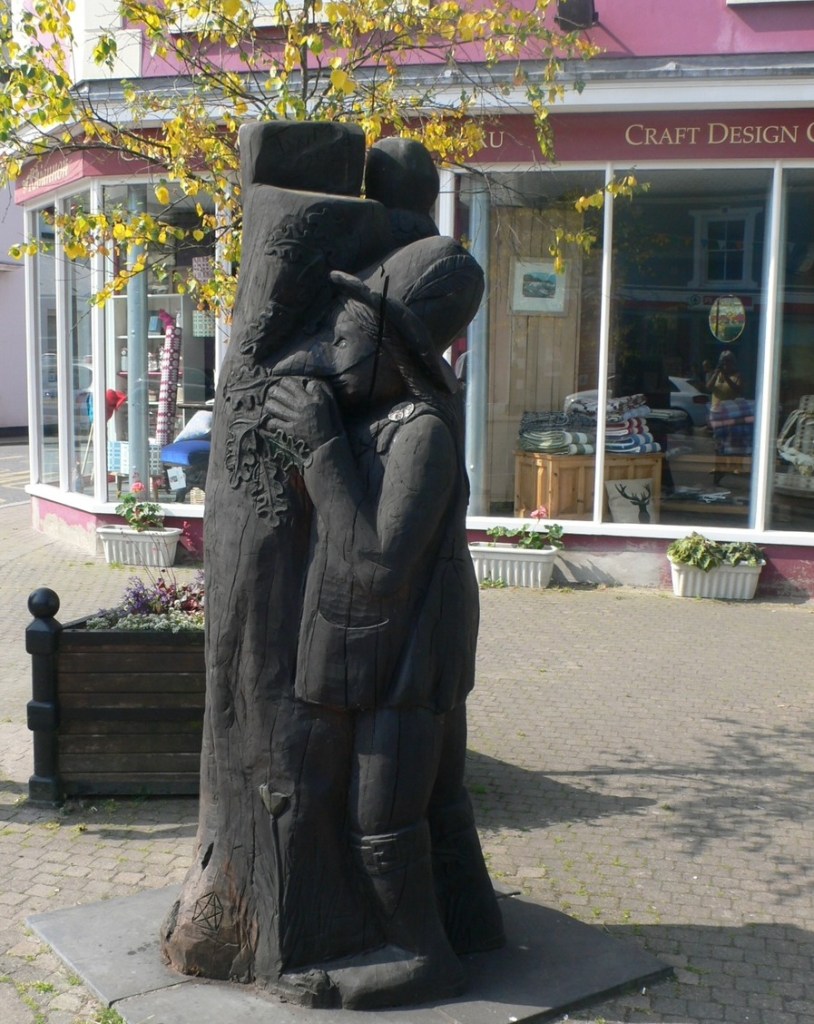
Not bad for a tale that began with a boy from a farm near Tregaron, where a carved statue of Twm by Grace Young Monaghan has stood on the square since 2009, four hundred years after his death. Nottingham has the films; the Towy valley has the paperwork, the poetry and the cave.
Related stories from Swansea Bay News
CARMARTHENSHIRE: RSPB buys 96-hectare ‘missing link’ to reconnect a rare Welsh rainforest
The purchase that made Gwenffrwd-Dinas whole again after 60 years.
RIVER TOWY: Extra water released from Llyn Brianne as drought leaves river running low
The reservoir at the top of Twm’s valley propping up the river this summer.
EASTER OPENING: Final stretch of Tywi Valley Path set to welcome walkers and cyclists
The valley’s other great walk, from Carmarthen to Llandeilo.
New Swansea Railway Station mural celebrates the city’s past, present and future
Where Twm Siôn Cati appears among the figures of Welsh history.
Discover more from Swansea Bay News
Subscribe to get the latest posts sent to your email.