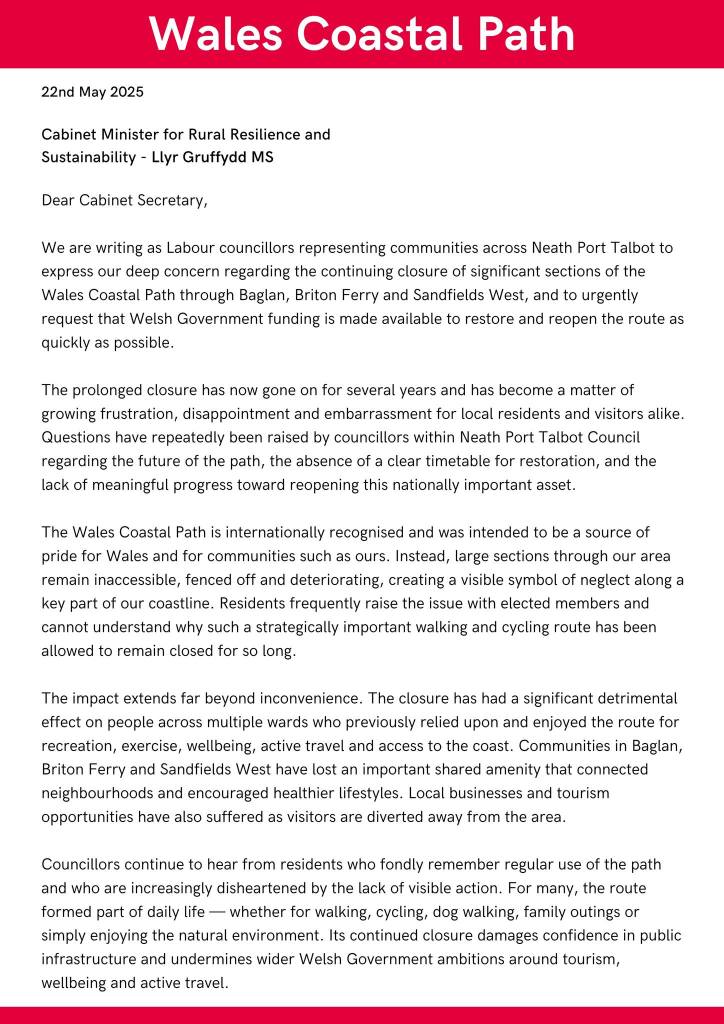
Twenty opposition Welsh Labour councillors from Neath Port Talbot have written to the new Welsh Government Cabinet Minister for Rural Resilience and Sustainability demanding urgent action and funding to reopen long-closed sections of the Wales Coastal Path through Baglan, Briton Ferry and Sandfields West — a stretch that has now been fenced off for more than two years over fears of subsidence and sinkhole collapse.
The letter, sent this week to Plaid Cymru MS Llŷr Gruffydd — who took on the newly created rural resilience portfolio when Plaid Cymru formed Wales’s first ever Plaid-led government earlier this month — lands at the heart of a long-running political dispute over who should pay to fix a deteriorating path on land owned by the Welsh Government and maintained, until 2023, by the council.
Campaign led by three local councillors
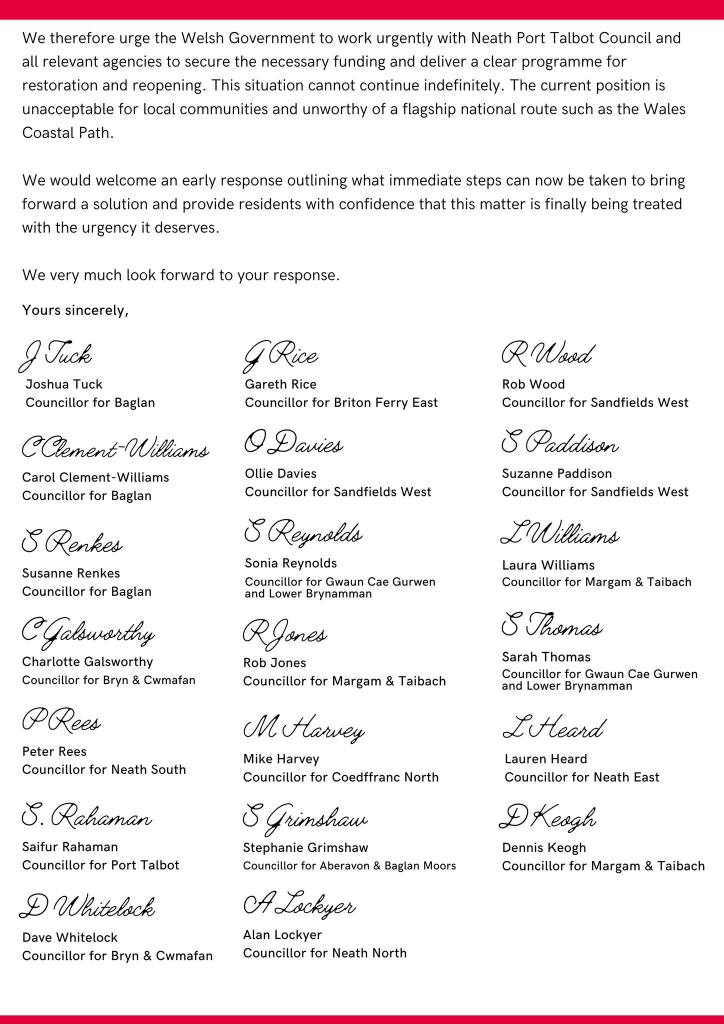
The campaign for the path’s reinstatement has been led by Cllr Josh Tuck (Baglan), Cllr Gareth Rice (Briton Ferry) and Cllr Rob Wood, whose wards either border or contain the closed section. This week’s letter to the Cabinet Minister has been signed by 17 of their Welsh Labour colleagues from across the borough.
Cllr Rice’s ward of Briton Ferry contains the stretch of path that runs alongside the Briton Ferry estuary — where the original closure was made in April 2023 after the path was deemed too dangerous to use.

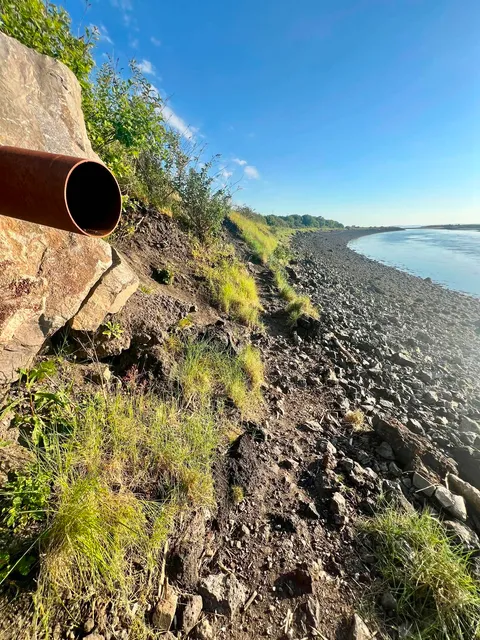
(Image: Cllr Josh Tuck)
Closed since April 2023
According to the council’s own official response to a 2024 enquiry from Aberavon and Maesteg MP Stephen Kinnock, the section was closed in April 2023 because of “subsidence connected to the formation of sinkholes, which unfortunately made the path hazardous to use.”
The same letter, written by NPT’s Head of Planning and Public Protection Ceri Morris, set out a longer history of problems. Repair schemes had been carried out approximately every four years since 2012 to fill or bridge the sinkholes that were continually forming in the area — but those works “did not address the wider problem that is affecting the adjacent land.”
By early 2023, the council said, officers had noticed new cracks opening up along the path. “The Authority considered it had no option other than to close the path on safety grounds,” the letter said.
Walkers were redirected along the cycle route from The Quays Offices, passing through the industrial estate to pick up the Wales Coast Path connection at Purcell Avenue.
Walkers using eroded unofficial route around closure
More than two years on, councillors say walkers are increasingly bypassing the official closure altogether and using an unofficial route through eroded ground alongside the fencing — raising fresh concerns that the closure may be creating new safety risks rather than removing them.
The letter from the 20 councillors describes the closures as “a visible symbol of neglect along a key part of our coastline” and says that despite repeated questions to Neath Port Talbot Council from elected members, no clear timetable has ever been provided for restoration.
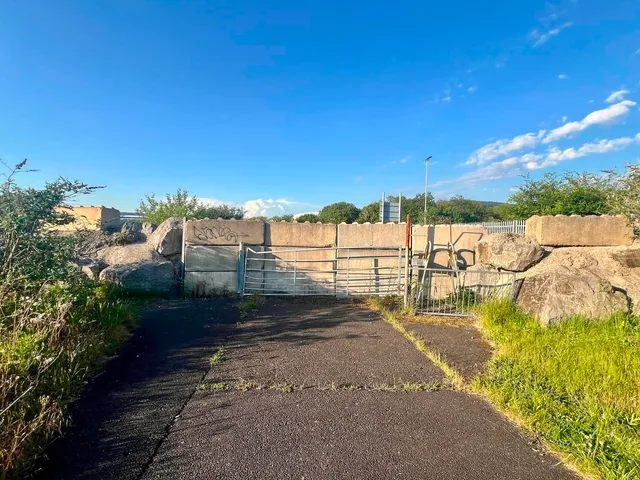
(Image: Cllr Josh Tuck)
March 2024: borehole testing
The council’s 2024 response confirmed that NPT had used Wales Coast Path funding in March 2024 to carry out “an extensive bore hole testing scheme to ascertain the extent of the issues in this area.” Officers were said to be reviewing the final report to ascertain whether the route remains feasible for future use as the Wales Coast Path.
But the council was clear that reopening depends on funding from above. “Whilst it was not the Authority’s intention to permanently close this section of the path, ultimately it comes down to whether funding becomes available from Welsh Government,” Mr Morris wrote.
The official council position has been that NPT itself cannot continue to fund repeated repair schemes indefinitely — and that even if it did, the underlying subsidence affecting the adjacent land would mean the path could only be reopened on a temporary basis without a wider intervention.
A funding dispute the council says rests with Welsh Government
The closure has happened entirely under the current Plaid Cymru-led rainbow coalition, which took control of Neath Port Talbot Council in 2022 — meaning the path has been fenced off for almost the whole of this administration’s time in office.
Council leader Cllr Steve Hunt has previously stated publicly that the path “has nothing at all to do with NPTCBC” because the underlying land is in the ownership of the Welsh Government — placing responsibility for any repair work with whoever forms that government.
David Rees, who served as Welsh Labour MS for Aberavon until losing his seat at the May 2026 Senedd election, said in 2024 that he had been told by NPT that the council needed money from Welsh Government to fix the path, while Welsh Government had stated that the council had already received maintenance funding. “It is unlikely to re-open until this is resolved as the argument of people’s safety will be dominant,” he said at the time. Two years on, his prediction has held: the path remains closed.
“A flagship national asset”
The Wales Coastal Path is an 870-mile route around the entire Welsh coastline, launched in 2012 as the first dedicated long-distance walking route to cover an entire country. It is jointly funded by the Welsh Government and Natural Resources Wales, with day-to-day maintenance delivered by local authorities. The Welsh Government also owns the adjacent land affected by the subsidence — making it both funder and landowner in the dispute.
The letter from the 20 councillors describes the path as “internationally recognised” and intended to be “a source of pride for Wales” — but says that large sections through Baglan, Briton Ferry and Sandfields West remain “inaccessible, fenced off and deteriorating.”
A cross-party political map
The letter has been copied to all six Members of the Senedd for the new Afan Ogwr Rhondda constituency, which covers the affected communities under the new D’Hondt voting system introduced for the May 2026 election.
Those six MSs are Sera Evans, Alun Cox and Elyn Stephens, all of Plaid Cymru; Benjamin Hodge McKenna and Steve Bayliss, both of Reform UK; and former Welsh Labour cabinet member Huw Irranca-Davies, who was elected Llywydd of the Senedd earlier this month and is now politically impartial.
Cabinet Minister Llŷr Gruffydd, MS for Clwyd, only took on the rural resilience brief on 13 May after First Minister Rhun ap Iorwerth appointed his first cabinet. The portfolio includes responsibility for Wales’s outdoor and natural environment infrastructure.
‘We loved watching the birds and wildlife’
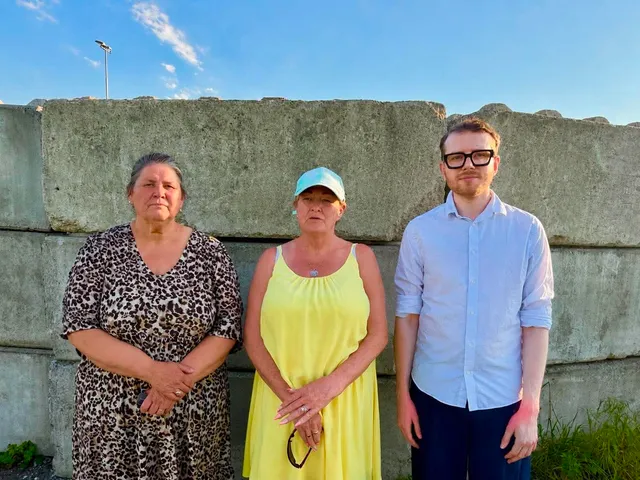
Baglan residents Gaynor and Graham, both members of the RSPB, said the loss of the path had stripped local people of a free, accessible community asset.
“The coastal path at Briton Ferry has always been a lovely, easy, flat walk for people of all ages,” they said. “Walkers from Neath and Port Talbot used it, not just residents of Baglan and Briton Ferry. It’s a local asset that’s free to use, and obviously helps people’s fitness, mental health and well-being. Apart from meeting people socially along the way, it really needs to be reinstated.
“For us personally, we loved watching the birds and wildlife as we are both members of the RSPB. In these challenging times it would be great to have somewhere that’s free to enjoy.”
Three areas of damage
The councillors set out three distinct impacts of the closures.
On health and wellbeing, the letter says the closures have cut off vital routes for walking, cycling and daily exercise relied upon by residents for years.
On active travel, the closures have severed key walking and cycling connections between Baglan, Briton Ferry, Sandfields and the wider Swansea Bay coastline.
And on local business and tourism, the councillors say visitors have been diverted away from the area’s seaside businesses, undermining wider Welsh Government ambitions around tourism and outdoor recreation.
“Unacceptable and unworthy”
Calling for a “clear programme for restoration and reopening,” the councillors describe the current position as “unacceptable for local communities and unworthy of a flagship national route such as the Wales Coastal Path.”
“Its continued closure damages confidence in public infrastructure and undermines wider Welsh Government ambitions around tourism, wellbeing and active travel,” the letter states.
The 20 signatories
Alongside Cllr Josh Tuck, Cllr Gareth Rice and Cllr Rob Wood, the letter is signed by Cllr Carol Clement-Williams (Baglan), Cllr Suzanne Paddison (Sandfields West), Cllr Sarah Thomas, Cllr Laura Williams, Cllr Mike Harvey, Cllr Lauren Heard (Neath East), Cllr Stephanie Grimshaw (Aberavon and Baglan Moors), Cllr Saifur Rahaman and Cllr Alan Lockyer (Neath North), together with the Welsh Labour ward councillors for Margam and Taibach and for Port Talbot.